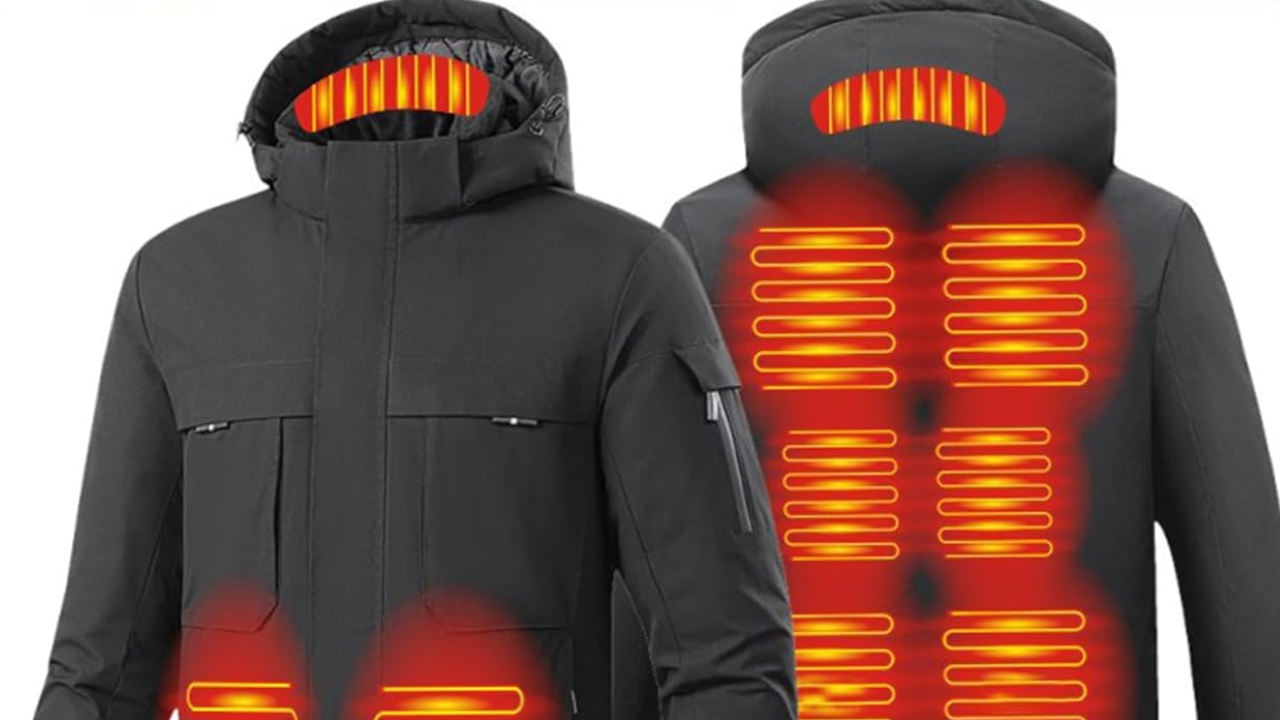
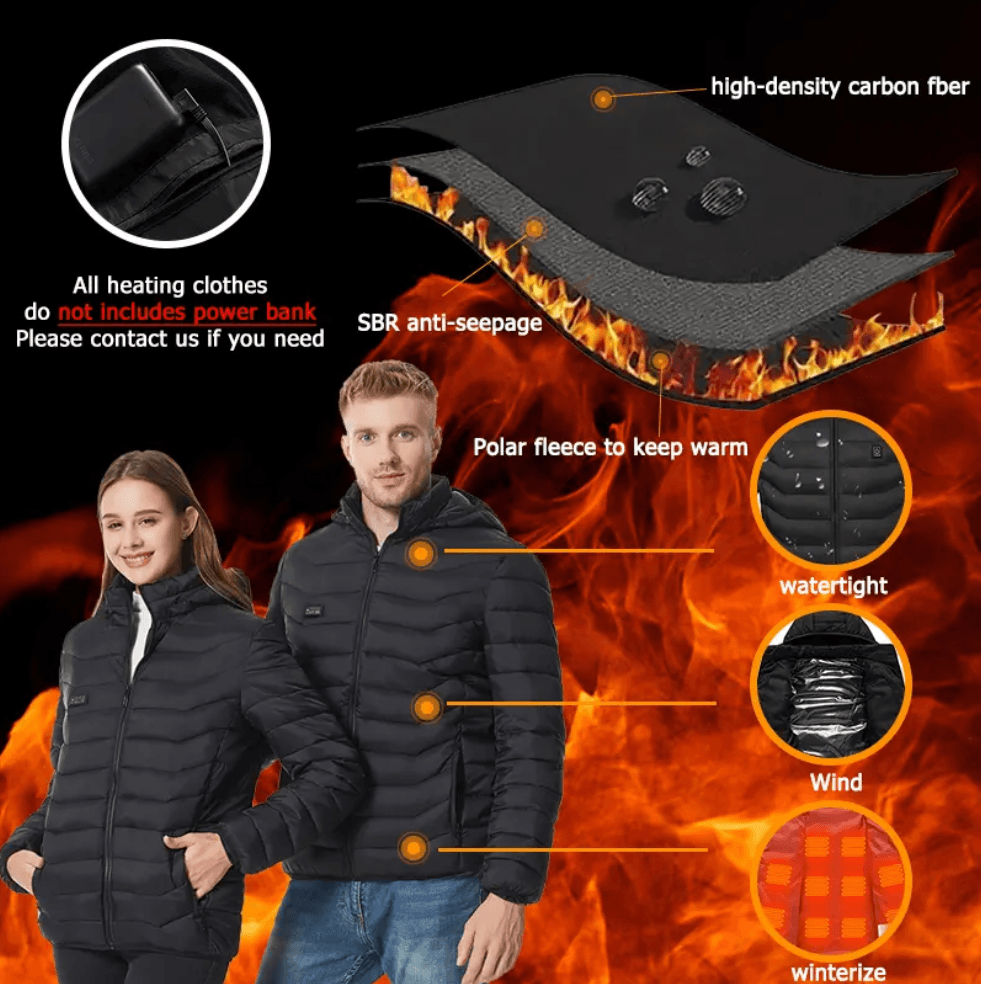
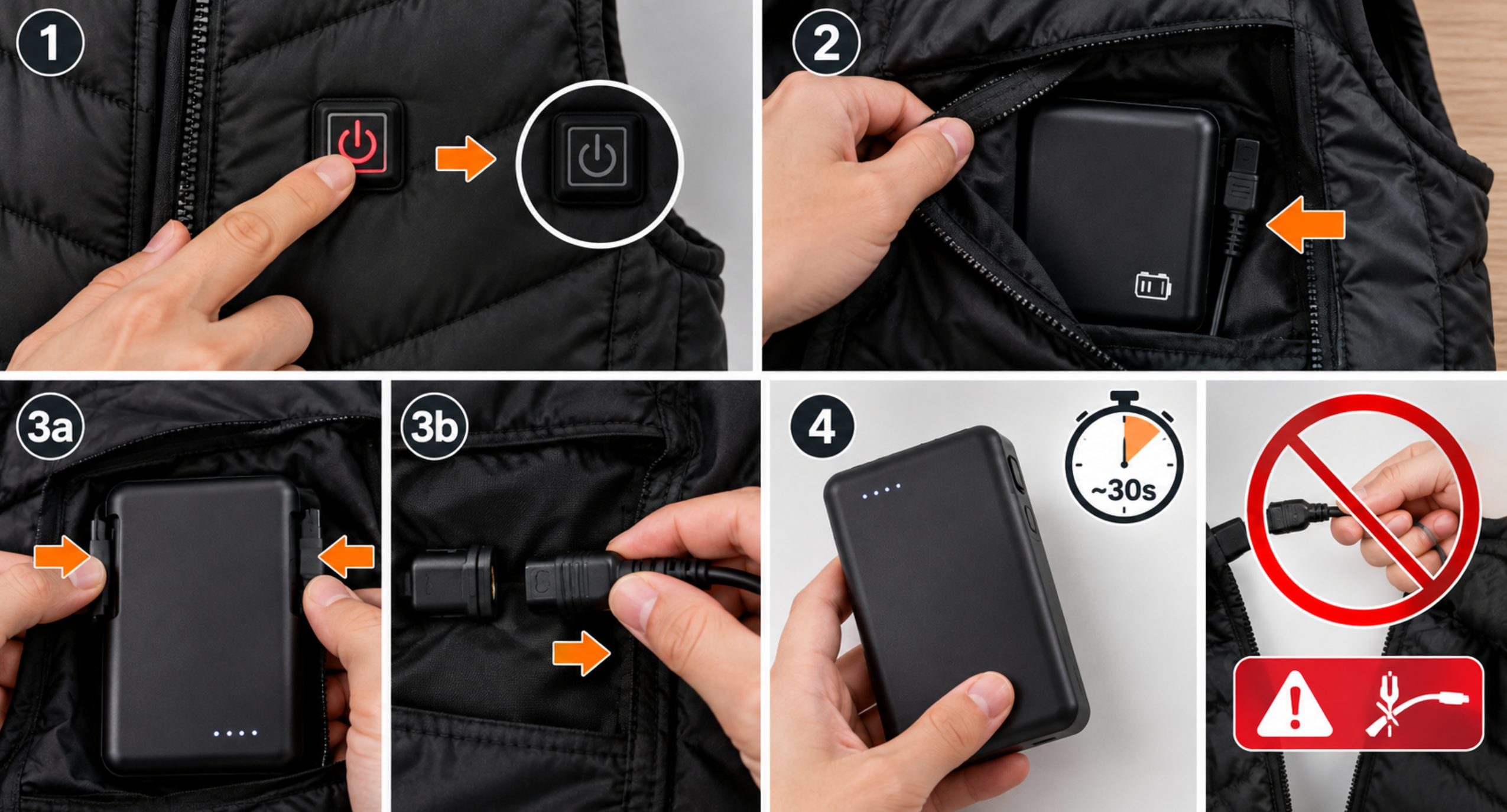
Price tags that rival a decent winter coat, batteries that die when you need them most, and a layering problem nobody mentions in ads keep heated jackets niche. We break down the eight real reasons, clear up misconceptions that keep good products under-bought, and show you who these jackets are actually worth the money for.
The High Price Barrier: Why Heated Jackets Cost $150-$400+
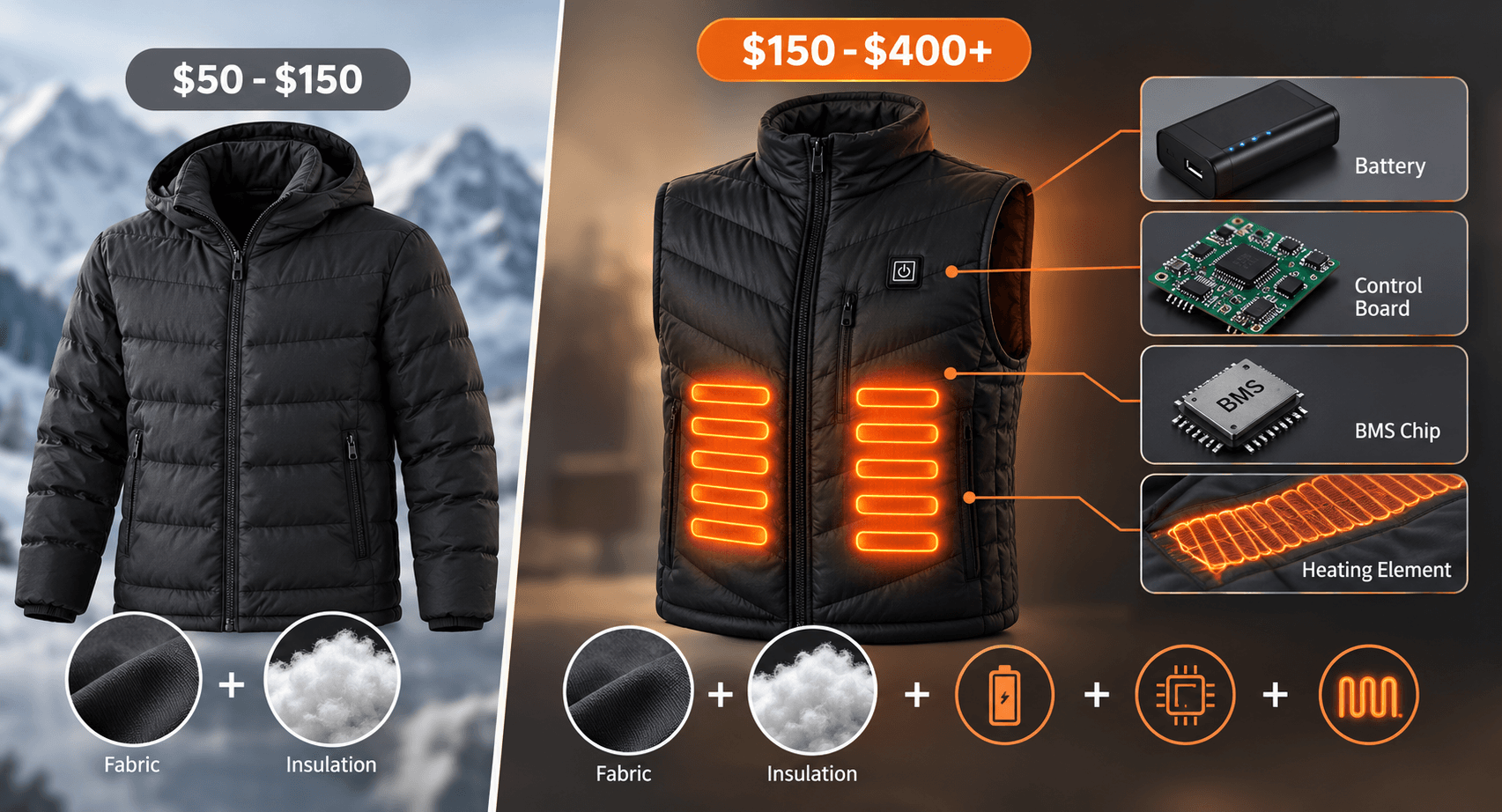
A regular winter coat is just fabric and insulation. A battery heated jacket is fabric, insulation, and a small electronics project sewn into its lining. The higher price comes from the battery, control board, BMS protection chip, and heating element that a standard coat never needed.
Where the money goes:
Heating elements: $2-15 per unit (carbon fiber runs $5-15, graphene $5-8)
Battery pack: $10-30, often 28% of total manufacturing cost alone
BMS + control PCB: $1.30-5.25 combined
Wiring, connectors, fabric, trim: the rest
Factory-level manufacturing costs land at $10-20 per jacket. A more detailed private-label breakdown puts FOB cost around $41.75, with battery and heating system components eating 33-47% of that total. Retail markup, certifications, and channel margins then push the sticker price into $150-$300 territory for standard models, with premium electric heated jacket options crossing $400.
Reddit users compare a $35 budget jacket against a $100 model and ask whether the price jump buys better warmth or just better marketing. It's a fair question – heated apparel market pricing doesn't always track performance.
The Battery Burden: Charging, Weight, and Runtime Anxiety
Crank your heated jacket to high, and you're looking at 2-4 hours of runtime. Drop to medium and you get 4-6 hours. Low setting stretches to 8-10 hours—but that's barely lukewarm on a genuinely cold day. Most people end up toggling between settings just to make it through, landing on what's realistically a 4-5 hour window of usable heat before the jacket becomes a regular coat with dead weight sewn in.
Ororo's lineup shows this pattern clearly. High settings typically deliver 3-4 hours, with some full-zone models dropping to just 2 hours. Outdoor Life's testing found similar swings: 2.5 hours here, nearly 5 hours there, depending on the model and setting combo. This is the baseline experience across the heated apparel market.
The real anxiety is three specific failure points. Forgetting to charge overnight turns your $200 investment into a regular jacket. Watching the battery die mid-shift on a job site or halfway through a ski run is another. And bumping to high when temperatures drop leaves you with maybe 90 minutes left.
The weight problem compounds this. Battery packs run 4-8 oz on average. Venustas's 4800mAh pack weighs about 6.56 oz (186g) in a roughly 3.15 x 2.60 x 1.02-inch housing. That sounds negligible until you're sitting, biking, or wearing a backpack. The pack doesn't distribute evenly; it sags on one side, presses into your ribs when you lean back, and creates a noticeable pocket bulge. Industry specs call this a "6-12 oz bulky power pack" for a reason: weight alone undersells how it actually feels against your body for eight hours straight.
The Heated Jacket Needs a Layering System
Marketing photos show someone in a heated jacket standing in the snow with nothing else on. That image sets an unrealistic expectation. A battery heated jacket is an adjustable core-warming layer that needs a proper layering system around it.
The physics of how it works:
Heating elements work best close to your skin. Wear a moisture-wicking base layer underneath the jacket.
Below roughly 20°F, especially with wind chill, the jacket is a supplemental heat source. You still need a windproof, waterproof outer shell.
A standard setup is: base layer, then heated jacket or vest, then a puffy down jacket, parka, or hardshell.
Buyers often expect one heated garment to do a winter coat's entire job. It won't hold up in sustained wind, wet snow, or long static exposure. That's a real disadvantage buried in most comparisons.
It works well on construction sites, commutes, hunting stands, and ski lifts. The jacket handles core heat while your movement and the outer shell take care of the rest.
Maintenance Complexity vs. Traditional Jackets
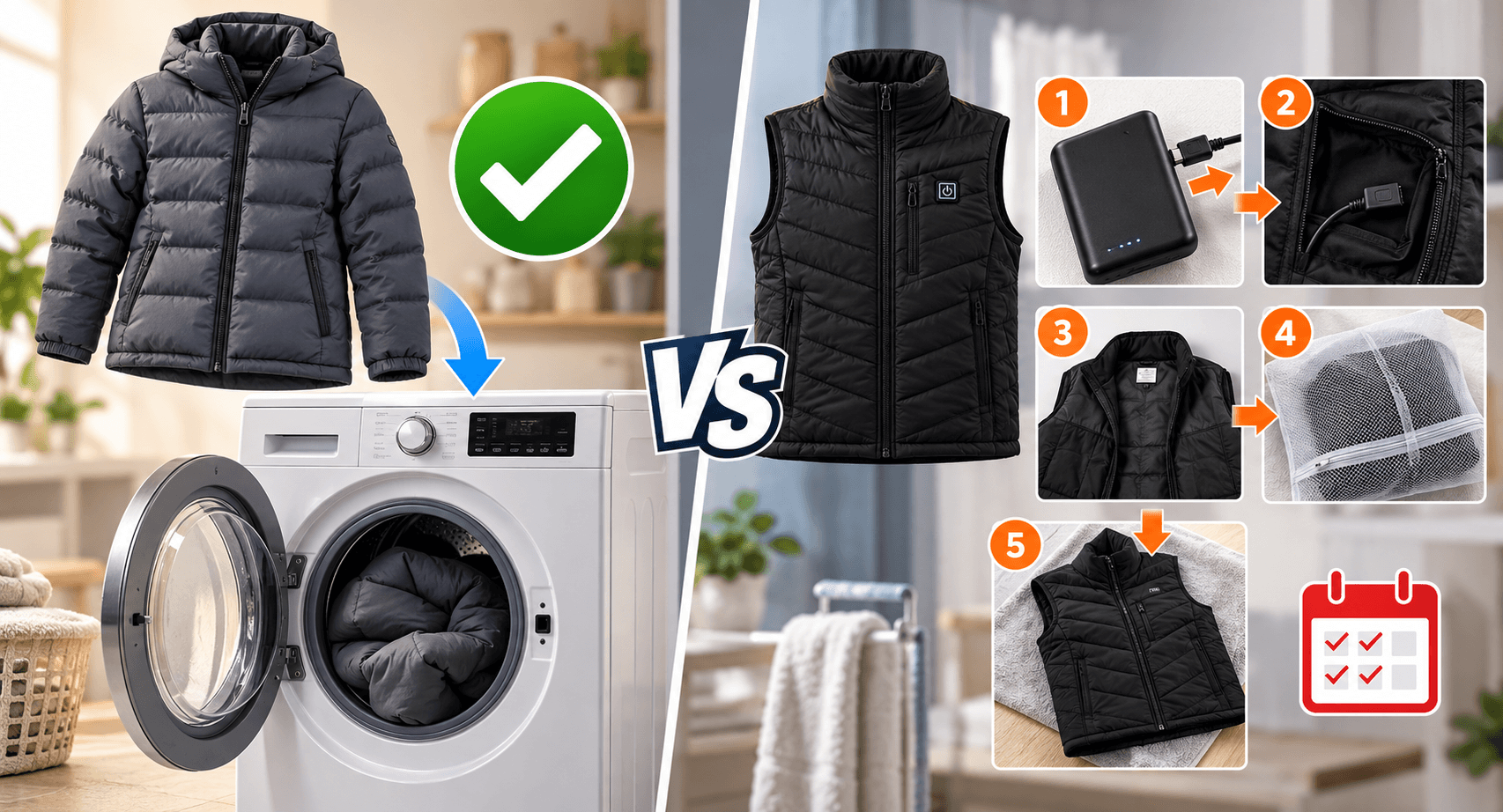
Throw a regular winter coat in the wash, hit the machine-wash setting on the tag, and walk away. That's the whole process. A battery heated jacket turns laundry day into a checklist.
Washing a heated jacket requires several steps. Power down and remove the battery before anything touches water—skip this and you risk a short circuit or battery damage. Tuck the wiring back into its dedicated pocket and zip it closed so the machine’s agitation doesn’t yank on internal connections. Use a mesh laundry bag, cold water, and a gentle or hand-wash cycle. Stick to mild detergent—no bleach, no fabric softener. Skip the dryer completely; high heat melts wire insulation and can shrink the fabric around heating elements. Never wring or twist it; that motion bends carbon fiber heating wires and creates dead zones where heat stops working. Air dry for 24-48 hours before reconnecting the battery—residual moisture plus electronics is a bad combination.
Compare that to tossing a Patagonia parka in with your regular laundry. Regular jackets cost you time. Heated jackets cost you time, careful memorization of five “never do this” rules, and real risk to a $200+ investment if you get any step wrong.
Style Sacrifice: Function Over Fashion Limitations

Nobody's wearing a heated jacket to look sharp. The honest trade-off is warmth over style.
The typical heated jacket versus regular jacket comparison isn't close on aesthetics. Traditional jackets span denim, bomber, puffer, softshell, wool, trench, workwear, slim-fit—dozens of silhouettes for different moods and occasions. Heated jackets come in four shapes: softshell, puffer, workwear, and hooded. The battery pocket, chest wiring, and heating zones dictate the cut, and there's not much room to deviate.
Reviewers name the same complaints. "Somewhat bulky with thicker insulation" shows up often. So does "slightly lacking on the style front." One tester put it plainly: "We're willing to make style sacrifices for ultimate warmth and comfort."
Fit problems split by gender.
Women report unisex cuts that run straight through the torso. The shoulders are too wide, sleeves too long, and nothing fits like a real jacket should.
Men get functional gear that reads as workwear, not something you'd wear to dinner or the office.
Seasonal Limitation: Why Year-Round Value Feels Weak
Google search data tells the real story. Interest in "heated jacket" spikes hard in November, stays elevated through December, then flatlines the rest of the year. The pattern backs up what shoppers suspect. This is a winter-only purchase. The math around that seasonal window decides whether the jacket feels like a smart buy or a shelf ornament.
The cost-per-use split tells two different stories.
A $200 jacket worn daily through a 90-day winter works out to $2.22/day in year one, dropping to $0.74/day across three winters.
A tradesperson wearing it 180 days a year gets $1.11/day, then $0.37/day over three seasons.
For a workwear benchmark, a $199 heated jacket used roughly 60 days per season for three years lands near $1.10/day.
Below 15 uses per season, the value proposition weakens fast. Industry analysis puts the compelling threshold at 30+ uses. Someone wearing it just 20 days a year is looking at $10/use in season one—the exact math that fuels "not worth it" reviews.
Low Awareness and Weak Consumer Education
Most people don't buy heated jackets because most people don't know they exist. That is a measurable gap. A study of 646 respondents found only 36.5% had heard of "smart clothing with heating functions." Another sample found that only 9% knew this category existed. Heated clothing technology is niche because nobody has explained it.
The education gap shows up in two places. First, no awareness leads to no search intent. If you don't know heated jackets exist, you are not typing "heated jacket" into Google. You search "what to wear for winter commute" instead and never land on the product that would solve your problem. Second, no understanding leads to no purchase. Consumers who do stumble onto a battery heated jacket focus on warmth, comfort, and ease of use. They are not thinking about heating elements or battery specs. They want to know: how hot, how long, is it safe? Skip that explanation and you lose the sale before you pitch a single feature.
Search behavior compounds the problem. "Heated jacket" pulls over 30,000 results on Amazon alone. That's a wall of noise for someone who is only 36% likely to know what they are looking for in the first place. When low awareness and high competition meet, conversions stall. Shoppers get lost before they get informed.
Industry reports list "improving consumer awareness" as a growth driver for the heated apparel market. That is an admission that the product works, but the messaging hasn't caught up.
Trust and Safety Concerns: Addressing Electrical Fears
A wearable heating element three inches from your spine makes you wonder what happens if it malfunctions. Forum threads and reviews keep circling the same fears—localized hot spots that could burn skin, battery swelling from overcharging, exposed wiring that might spark, and that faint burning smell nobody wants near their jacket. These are rational worries, and they explain why heated jacket disadvantages get discussed more than benefits in comparison threads.
The certifications that actually answer these fears:
UN 38.3 covers lithium battery safety during shipping, drops, pressure, and thermal stress. IEC 62133 and UL 2054 cover battery cell safety standards. CE (EMC plus low-voltage safety) and RoHS set the EU baseline for electrical products and material safety. UL 2056 and UL 2271 cover battery pack and system-level safety, common in North American electric heated jacket certification. FCC Part 15B covers electromagnetic compliance for chargers and control circuits.
IceBearCare publicly references CE, RoHS, and UN 38.3 test arrangements across its battery-powered lines, pairing battery-level safety with whole-garment compliance. Before you buy, check that battery, charger, and full jacket are verified separately. A logo on a tag isn’t enough.
Who Heated Jackets Actually Work Best For
The price tag and battery anxiety we covered above only make sense for a narrow slice of buyers. Not every cold-weather scenario justifies it.
Four groups get real value: outdoor workers, hunters, cold-weather commuters, and people with circulation issues. The common thread is simple—2+ hours daily in cold weather, or long stationary exposure where your body isn't generating its own heat through movement.
The numbers back this up. Quality heated jackets raise perceived warmth by 20-40 degrees above ambient temperature. Medium settings often feel like adding 1-2 insulating layers.
Who should skip it: short walks to the car, mild climates that rarely drop below 40°F, or 15-30 minute outdoor stints. Not enough usage to justify the cost. That's the honest answer, not a sales pitch.
Match your actual cold exposure to this list before you start comparing heated vest vs jacket options or scrolling through specs.
Heated Jacket vs. Traditional Insulated Jacket
Side by side, the differences come down to which trade-offs you're willing to live with.
Feature | Heated Jacket | Traditional Insulated Jacket |
|---|---|---|
Heat source | Active electric, adjustable zones | Passive fill, fixed warmth |
Runtime | 3-4 hrs mid setting, drops 30-40% in cold | Unlimited, no charging |
Price | $100-$400 typical | $50-$230+ (Carhartt Yukon: $209.99-$229.99) |
Wash care | Remove battery, cold gentle cycle, air dry only | Machine wash, tumble dry fine |
Weight | Heavier, battery adds bulk | Lighter, simpler build |
Running cost | ~$0.01-$0.05/charge, $20-$50 battery every 2-3 years | Zero ongoing cost |
If you want on-demand heat you control, go heated. If you want zero maintenance and all-day warmth without a charger, go traditional.
Conclusion
Heated jackets haven't gone mainstream because they ask a lot of you—more money upfront, more maintenance, and more trust in tech you can't always see working. The price tag, battery anxiety, and steep learning curve are real barriers. But for the right person—someone standing outside for hours in genuine cold—a well-built battery heated jacket beats layering up every single time.
The disadvantages we've covered are a checklist. Use them to separate a smart buy from an overpriced gadget. IceBearCare strips out the friction points that keep most heated jackets from earning their price tag: better battery life, simpler controls, and real cost transparency.
Go check IceBearCare's lineup.