Ever unzipped your jacket in disbelief because a thin vest somehow throws off more heat than your bulky parka? That's carbon fiber heating elements doing exactly what they're engineered to do. Strip away the buzzwords and you'll find a battery, a heating element, and a control chip working in sync to turn stored energy into steady, targeted warmth. We're going to walk through that entire chain, from the moment you press the power button to the way heat spreads across your back and chest, so you understand exactly what you're paying for. By the end, you'll know enough about batteries, heating zones, and safety features to spot a well-engineered vest from a gimmick.
The Core Technology: How Heating Elements Generate Warmth
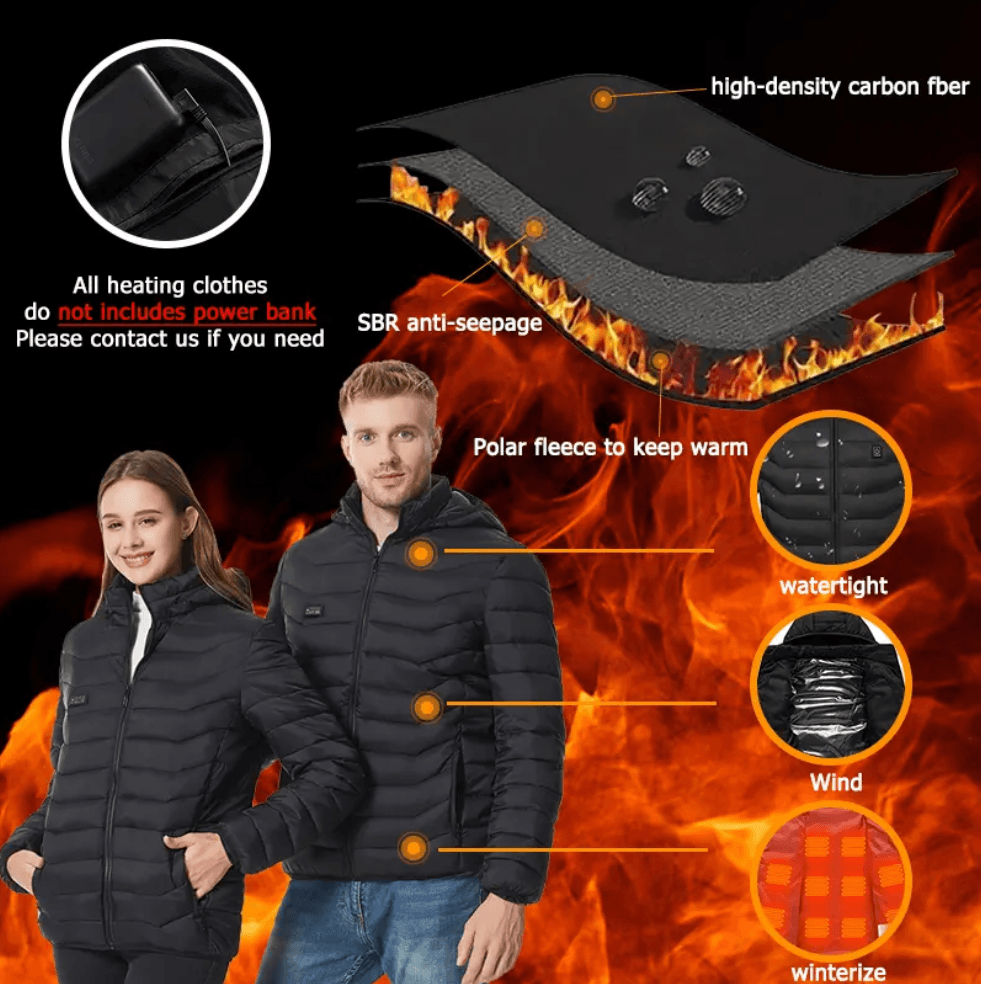
Physics does the heavy lifting. When electricity runs through a conductive material, electrons collide with the atoms in that material's structure, and those collisions release energy as heat. Engineers call this Joule heating, and it follows a simple formula: P=I²R. More current or higher resistance means more heat. Think of electricity jogging through a conductive path, generating friction that warms your back and chest.
Speed matters just as much as heat output. Nano-carbon heating systems can stabilize in 100 to 150 seconds, and high-performance fiber heaters can climb temperature at rates exceeding 1000°C per second. That's why flipping on your vest's heated vest temperature settings delivers warmth almost instantly, not after a five-minute wait.
Comparing the Three Main Heating Materials
Not all carbon fiber heating elements are built the same. Manufacturers choose between three materials, each with tradeoffs:
Carbon fiber: Thermal conductivity of 400–650 W/m·K. Runs under 10V and exceeds 200°C quickly. Its real strength is durability—carbon fiber holds up structurally over years of wear.
Graphene: The heat conduction champion, with values ranging from 2000–6000 W/m·K depending on form. It heats fast but is pricier to manufacture at scale.
Carbon nanotubes (CNT): Around 2000–3000 W/m·K, but incredibly flexible. CNT heaters can hit 150°C at just 25–100V, making them ideal for stretchable, fiber-based electric heated clothing.
If you're ranking pure conductivity, graphene wins, CNT comes second, and carbon fiber trails—but carbon fiber wins on long-term durability, which matters more for everyday heated vest insulation.
Why Thin Fabric Can Outperform Bulky Parkas
Heating elements get built into fabric three ways: as ultra-thin sheets (some graphene paper hits sheet resistance below 0.1 Ω/□), woven directly into yarn fibers for even heat distribution, or spray-coated onto textile surfaces. None of these require thick wiring. The heat generates right where you need it, using nanoscale conductive networks instead of bulky metal coils. That's why a slim vest can outperform a heavy jacket.
Battery Power System: From Charge to Heat
Every heat cycle starts with a rechargeable lithium-ion or lithium-polymer pack. Press the button, and current flows from that pack through a control circuit, then out to the heating element—usually a large-area back panel or a multi-zone system spread across your chest and shoulders. That's the whole chain: battery, controller, heat.
Most heated vests run on 5V or 7.4V battery packs, with capacities from 5,000mAh to 20,000mAh. Voltage and capacity together determine how long you stay warm, which brings us to the number everyone cares about.
Real Runtime Numbers for Heated Vest Battery Life
A 10,000mAh pack is the industry's go-to benchmark. Here's what you get:
Low heat: 8–12 hours
Medium heat: 5–7 hours
High heat: 3–5 hours
One 7.4V/10,000mAh system (74Wh) claims up to 20 heating hours on a single charge. That's an outlier on the high end. More common are smaller controller batteries: a 7.4V/2.2Ah/16.3Wh pack runs 2.5–7.5 hours, while stepping up to 7.4V/4.4Ah/32.6Wh stretches that to 5–14 hours. Bigger Wh rating, longer runtime—simple math.
What matters for shopping: a 10,000mAh battery gets you through a full workday on low or medium, but only about half a day on high.
USB Rechargeable Heated Vest Batteries vs. Old-School Compartments
Older heated jackets used dedicated battery compartments or proprietary lithium controllers. Functional, but rigid. You needed the exact matching charger, every time.
USB rechargeable heated vest designs fixed that. Now the battery doubles as a power bank, chargeable from any USB source—your laptop, a wall adapter, even a portable charger in your bag. No hunting for a specific cord at 6am.
Temperature Control Mechanism: How Heat Settings Work
Three buttons, three temperatures, one big difference in comfort. Most heated vests have three temperature settings: High (60–65°C), Medium (50–60°C), and Low (45–50°C). Some brands use different splits like 45-55-65°C or 50-60-70°C. Either way, expect ±2°C accuracy on a well-built system—tight enough that you won't notice the controller hunting for the right heat.
You switch settings either by pressing once to cycle High → Medium → Low → Off, or by using dedicated buttons for High, Medium, or Low, with an LED or icon confirming your choice.
Behind that button sits real hardware: a temperature sensor, an MCU control board, and a relay or power driver. The sensor reads your vest's surface temp, the MCU compares it against your chosen setting, and the relay switches power on or off to hold that target. Most systems build in a hysteresis buffer. Instead of flipping on and off every fraction of a degree, the vest lets temperature drift before re-triggering. That's what keeps heat steady instead of pulsing.
Safety Built Into the Settings
Safety depends on this same control loop. If the sensor detects overheating, the MCU cuts power automatically. No melted fabric, no burns. If you leave the vest running unattended, auto shutoff kicks in after extended use, protecting your skin and the heating element.
Higher-end vests add app control so you can adjust temperature remotely or set schedules. Basic three-button models skip these features.
Heating Zone Distribution: Where the Warmth Comes From
Not every heated vest warms your whole torso—zone count decides how much of you stays warm. More heating zones mean smarter placement, not just more heat.
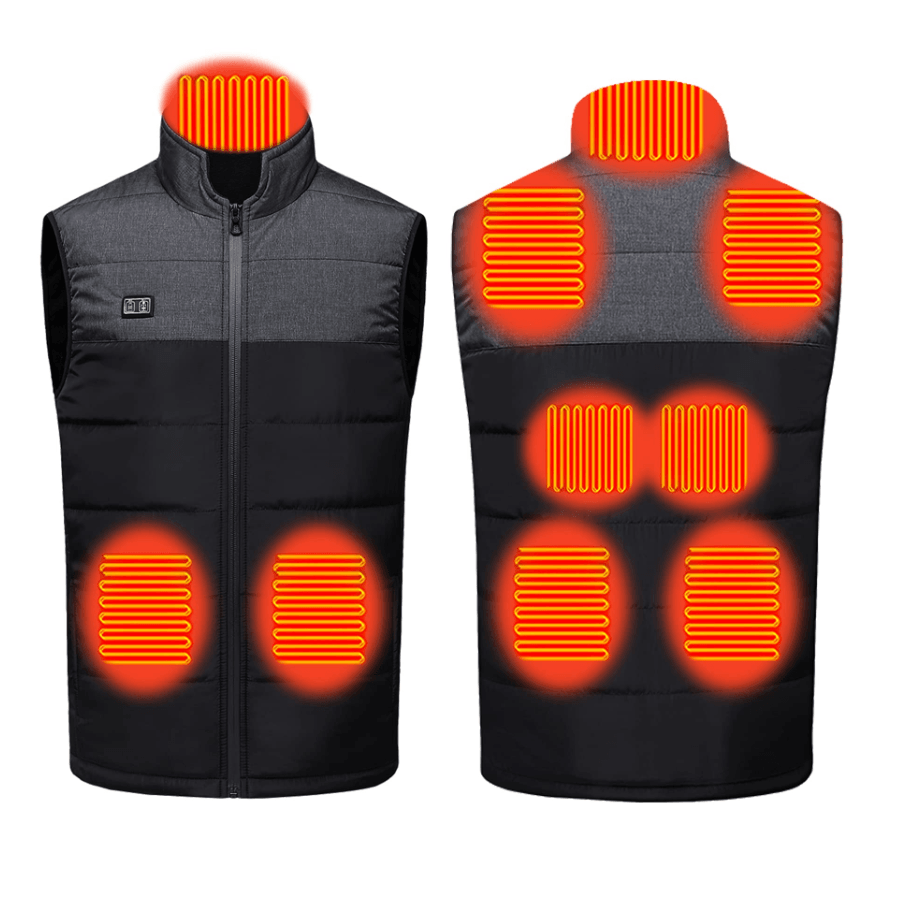
Zone Count Determines Coverage (and Price)
Zones | Typical Coverage | Price Example |
|---|---|---|
2-zone | Left/right chest only | Budget entry |
3-zone | Chest + upper back or collar | Ororo fleece vest, $149 |
4-zone | Front chest + upper back + collar | Mainstream "sweet spot" |
5-zone | Left/right chest, upper/mid back, collar | Ororo 5-zone jacket, $279 |
7-zone | Shoulders, neck, mid/lower back, pockets | Ororo classic vest, £249.99 |
8-zone | Neck, back, chest, shoulders, waist | All-core marketplace models |
10–28 zone | Belly, back, waist, neck, shoulders (dense grid) | Premium marketplace models |
One 2024 consumer manual breaks down an 8-zone vest as 1 neck zone, 3 back zones, and 4 front zones, all driven by a single 7.4V/12,000mAh pack.
Why the Torso Gets Priority
Testing shows 5W of heat keeps your torso comfortable at 0°C, but not at −10°C—where you need more zones or higher output. That's why Icebearcare and most brands concentrate heating vest zones on the chest and upper/mid back first: it's the highest-comfort return per watt. Shoulders, neck, and collar show up in 7-zone-and-up designs, because those spots lose heat fast in wind but cost more battery to cover.
Real-World Performance: Runtime and Power Consumption
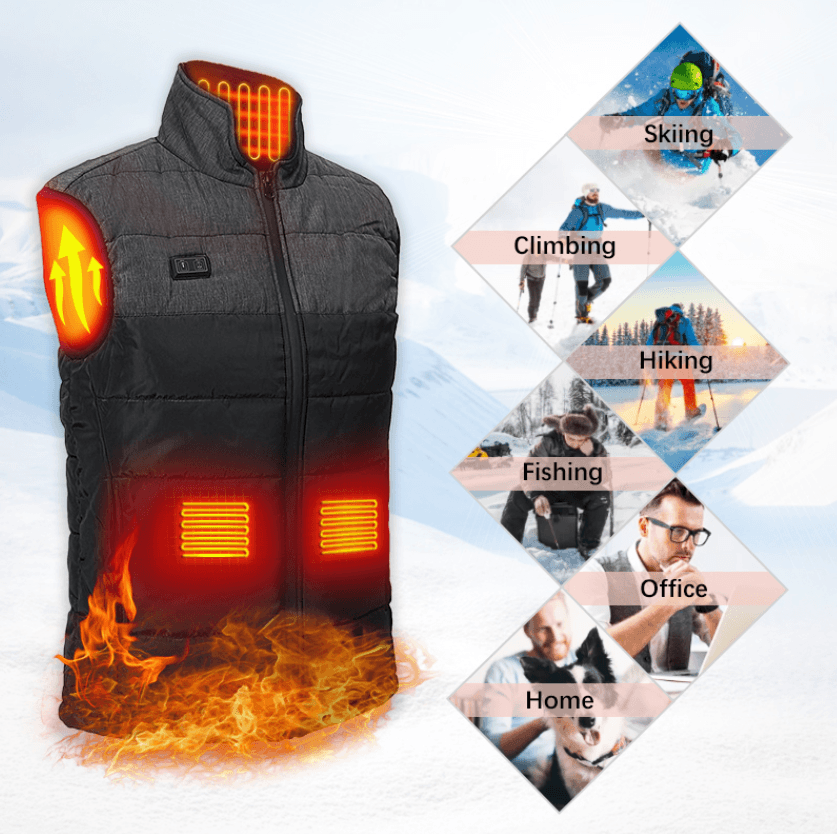
Manufacturer specs tell you what's possible. Real usage tells you what happens when you're standing outside in the wind for six hours. Here's the honest math.
Power draw scales directly with heat. Low setting pulls roughly 5–7W, medium sits at 8–10W, and high climbs to 12–15W or more. Run a 74Wh battery pack at 14.8W on high, and you get about 5 hours theoretically. Factor in conversion losses and cold weather, and that drops to a more realistic 3–5 hours—matching what most reviewers report.
Runtime by Battery Size
Battery capacity changes the equation fast:
7.4V/10,000mAh: ~14.8 hours low, ~9.3 hours medium, ~6.2 hours high
7.4V/14,400mAh: ~21 hours low, ~13.3 hours medium, ~8.9 hours high
5,000mAh: 6–9 hours low, but just 2.5–3 hours high
Bigger battery, longer runtime, but high heat always eats through capacity fastest.
What This Looks Like in Practice
Outdoor work with a 10,000mAh pack on medium covers 6–8 hours, enough for one full shift. Commuting one hour each way on low gets you through 4–5 days before recharging. Sitting still in cold, windy conditions is brutal on batteries. Expect 3–6 hours on high, 5–8 on medium, 7–12 on low.
To stretch runtime without buying a new vest, start on high to warm up fast, then drop to medium or low once you're comfortable. Pair with a windproof outer layer to reduce heat loss. And when comparing packs, check Wh, not just mAh. Voltage differences mean two "10,000mAh" batteries can deliver very different actual runtimes.
Safety Mechanisms You Should Know
Low voltage is the first safety net. Most heated vests run on 5V, 9V, or 14–18V systems, keeping dangerous mains voltage locked inside the external adapter. Your body only ever touches low-voltage DC. You still need overheat protection, auto shutoff, and adapter certification.
Three usage rules matter more than any spec sheet:
Never fold or pinch the heating panel. Creasing the carbon fiber heating elements under a backpack strap or seatbelt creates hot spots that can scorch fabric or skin.
Retire damaged units immediately. Frayed wires, burn marks, odd smells, or exposed conductors are fire and shock risks.
Match your charger exactly. An off-spec adapter invites overvoltage, overheating, or control failure.
Cleaning, Waterproofing, and Certifications
Always disconnect the power bank before cleaning. Never use the vest wet or damaged—stop and inspect first. Waterproofing follows IPX ratings: IPX4 for standard wear, IPX6 for ski layers, IPX7 for removable battery packs. For compliance, look for UN38.3 and UL 2054/IEC 62133 for batteries, plus CE, RoHS, and FCC Part 15B for the full unit.
What to Check Before Buying a Heated Vest
A good heated vest earns its price tag through five specs. Here's the checklist that separates a smart buy from a disappointing one.
Heating material speed. Carbon fiber and carbon nanofiber elements should hit noticeable warmth in 3–5 seconds in independent testing. If a listing can't confirm fast heat-up, skip it.
Zone count. Entry-level vests cover 3 zones (back plus left/right chest). Buy at least a 4-zone vest if you want chest, back, and neck or lower-back coverage together. Anything less feels patchy in real cold.
Battery capacity. A 10,000mAh USB battery is the industry benchmark, typically delivering 6–8 hours on medium. Go smaller only for short commutes; go 7,200mAh+ for full outdoor shifts.
Temperature range. Look for three settings spanning roughly 100–140°F (38–60°C); low for daily wear, high for fast preheating in serious cold.
Waterproofing and washability. Prioritize vests with a removable battery so you can machine wash the shell. Avoid anything that can't be disconnected before washing.
Quick Purchase Checklist
7.4V power system
At least 3 temperature settings
4+ heating zones
10,000mAh battery (or stated runtime)
Removable battery for washing
Overheat/short-circuit protection
Sizing matched to men's or women's fit
Many vests sell the battery separately. Budget for a 7.4V/10,000mAh pack if it's not included before checkout.
Conclusion
A heated vest sends battery power to carbon fiber heating elements. Those elements convert electricity into consistent, low-voltage heat, and a simple control chip lets you dial in your comfort level. Battery life, heating zone placement, and safety features separate a vest that actually keeps you warm on a freezing commute from one that dies halfway through your shift.
Now you know how heated vest battery life and heating zones really work. You can cut through marketing fluff and spot real quality when you see it. Check the wattage, check the certifications, check where the heating panels sit.
Browse IceBearCare's heated vest lineup and see engineered warmth in action.