Whether you’re checking out a cooling vest for outdoor work before buying, or you already own one and wonder if 90 minutes of cooling is normal or a sign something’s off, you need real numbers, not marketing fluff.
Ice pack cooling technology doesn’t work the same for everyone. A roofer in Phoenix gets different mileage than a warehouse worker in a climate-controlled facility, and both will see different results than an athlete pushing hard on a summer run. This guide covers exactly how long your ice packs will last, what cuts into that cooling time, and simple tricks—like proper pre-freezing and pack rotation—that stretch every minute out of them.
Ice Pack Cooling Vest Duration
Most ice pack cooling vests deliver 60 to 90 minutes of peak cold performance. After that initial blast fades, you'll still get 1.5 to 3 hours of steady, usable cooling. That's the range manufacturers and field tests confirm. Under ideal conditions (lighter activity, milder heat, bigger ice packs), top-tier setups can stretch to 3–4 hours before you need a swap.
Cooling Phase | Typical Duration | What It Means |
|---|---|---|
Peak chill | 60–90 min | Strongest cold sensation |
Steady cooling | 1.5–3 hrs | Average real-world performance |
Best-case | 3–4 hrs | Low exertion, larger packs, milder heat |
Plan on 1–2 hours of strong cooling, with 2–4 hours possible under the right conditions.
Key Factors That Affect Ice Pack Cooling Duration
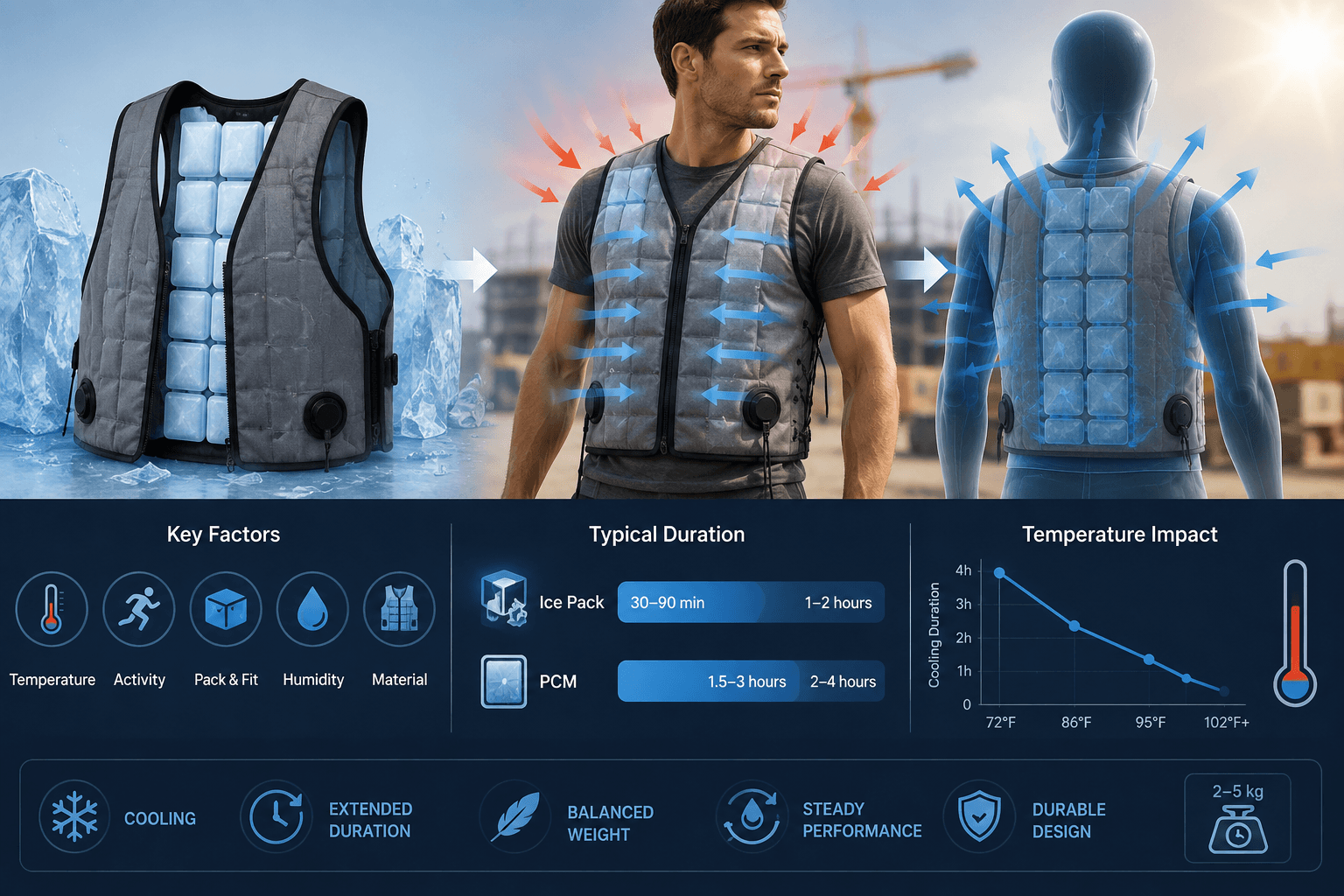
Not all cooling sessions are created equal. Five variables decide whether you get 90 minutes or 4 hours out of the same vest. Knowing them helps you set realistic expectations before you're sweating through a shift.
Environmental Temperature Changes Everything
Heat is the biggest lever. In temperatures above 95°F, effective cooling time drops from 1–2 hours down to 30–90 minutes. One field test with three frozen inserts running in 102°F conditions delivered about 2.2 hours of meaningful cooling before performance fell off sharply.
The bigger the temperature gap between the ice pack and the air (and your body), the faster heat transfers into the pack. That speeds up melting and shortens the cold plateau—the window where you actually feel relief. Push past 95°F, and your body's heat load outpaces what the pack can absorb. The cold sensation fades first, then the pack slowly becomes a lukewarm dead weight.
Activity Intensity Shortens Real-World Duration
Sitting still and working hard are two different math problems.
Low-to-moderate activity: ice/gel vests hold 1–2 hours; PCM cooling vests stretch to 1.5–3 hours (sometimes 2–4).
High-intensity work—hauling loads, cycling, active sweating, extended outdoor labor—cuts that down to 45–90 minutes. Some test conditions showed just 50 minutes.
Motorcycle riders and high-mobility users should plan around a 60–90 minute cycle, especially with wind resistance layered on top of exertion.
Athletes and outdoor workers running high metabolic output should estimate at the lower end: 1–2 hours for ice/gel, 1.5–3 hours for PCM—not the marketing max.
Pack Size, Quantity, and Fit Matter More Than You'd Think
More ice, bigger inserts, longer duration. Industrial vests running a 3-pack configuration held about 2.2 hours of usable cooling in high-heat testing—well above single-pack setups. A snug (not tight) fit also matters: less air gap means better heat transfer to skin, while loose vests create cold spots and shorter perceived duration. The tradeoff: fully loaded vests often weigh 2–5 kg, and that extra weight can increase exertion and sweat output, quietly working against your cooling time.
Humidity and Material Type: Ice vs. PCM Cooling Vest
This is where PCM cooling vest vs ice pack vest comparisons get interesting. Ice and gel packs rely on melting, not evaporation, so humidity doesn't hurt them directly. But they run colder initially, with a shorter 30–60 minute peak-cold window before tapering off fast. PCM vests hold a steadier 58–65°F plateau, typically lasting 1.5–4 hours. Because they also don't depend on evaporation, they handle humid environments more consistently than sweat-based cooling gear.
In moderate conditions (72–86°F, average humidity), PCM vests commonly hit 2–4 hours. Push into 95°F+ heat with heavy activity, and even PCM performance compresses toward that 1–2 hour range.
How to Maximize Your Ice Pack Vest’s Cooling Time
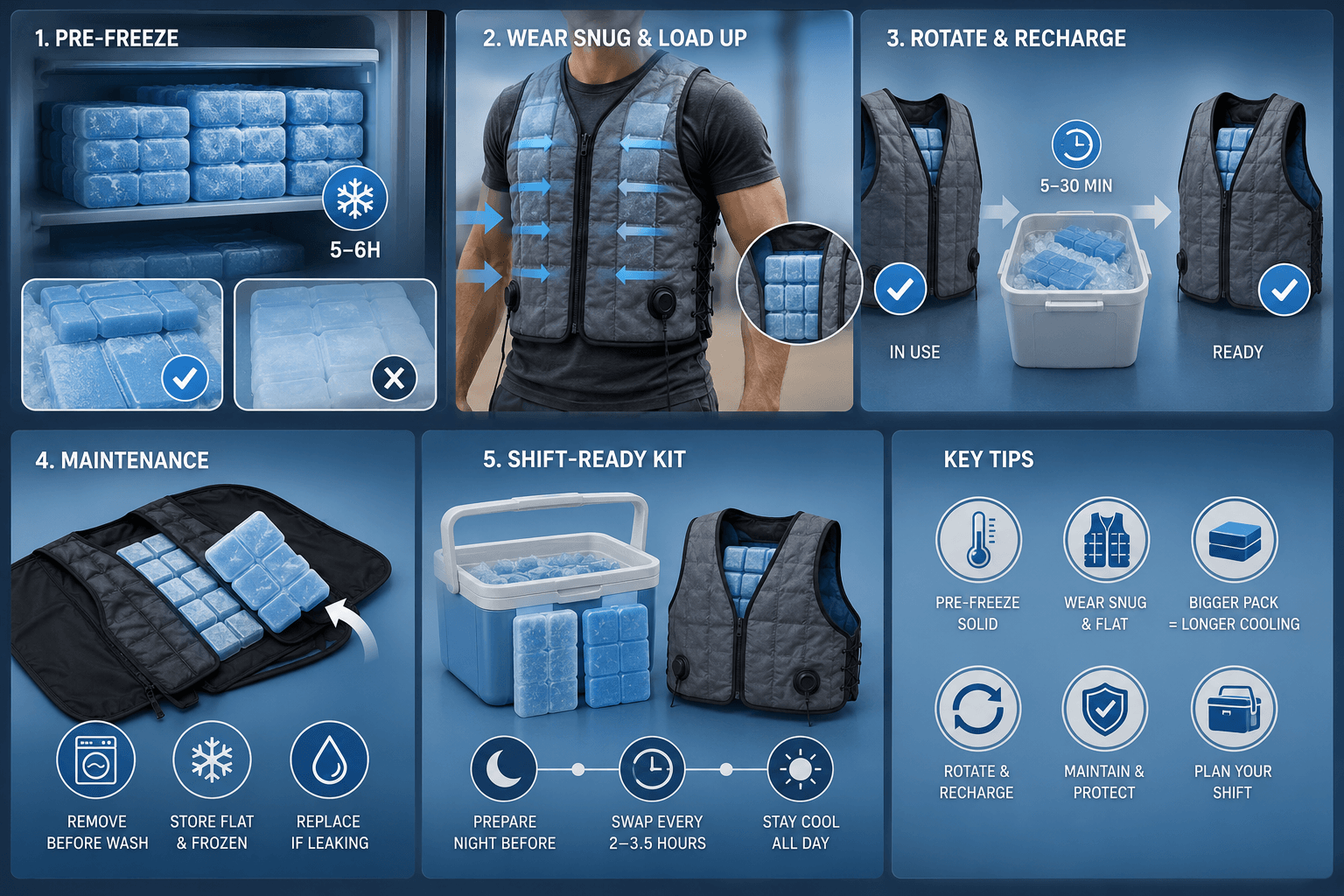
Three minutes of prep can buy you an extra hour of relief. The difference between a vest that quits at 90 minutes and one that runs a full 4 hours usually comes down to how you freeze, wear, and rotate your packs—not luck, and not a better product.
Pre-Freeze Properly (This Step Gets Skipped Constantly)
Standard ice packs need 5–6 hours at −18°C to −20°C to freeze solid. Skip the timer and eyeball it instead: packs should be completely rigid, “solid white,” and fully frozen hard before they touch your vest. Half-frozen packs melt fast and give you a fraction of the cooling window you paid for.
Overnight freezing (8–12 hours) consistently produces the longest runtime, so if you’re prepping for an early shift, load the freezer the night before, not the morning of.
PCM (phase-change material) packs work differently and recharge much faster: 15 minutes in a freezer, 25 minutes in a refrigerator, or 10 minutes in an ice-water bath. That speed is the whole appeal when you’re mid-shift with no freezer access—ice water alone can get you back in the game.
Build a Rotation System, Not a Single-Pack Plan
One set of packs will not carry you through an 8-hour shift, and expecting it to is the most common setup mistake. Keep at least one spare pack set per vest so one is cooling your body while the other recharges.
Recharge benchmarks to plan around: ice-water swap takes 5–30 minutes depending on pack thickness, and freezer swap takes 15–120 minutes depending on pack type. For duty-cycle planning, swap every 2 hours on standard ice pack systems, or stretch to every 3–3.5 hours if you’re running phase-change packs.
Fit and Pack Load: The Free Performance Upgrade
Cooling vest performance lives and dies on skin contact. Wear the vest snug and flat, not loose—air gaps between pack and skin kill efficient heat transfer. Pre-chill packs flat before loading them so they freeze evenly and sit flush.
Pack size matters more than most people assume. Larger pack loads have delivered up to 3 hours of strong cooling in extreme heat, versus roughly 1.5 hours for smaller packs under the same conditions. If your vest allows it, size up.
Maintenance That Protects Your Investment
Remove packs before washing the vest shell; soaking gel or PCM packs shortens their lifespan. Replace any leaking pack immediately—typical PCM gel lifespan runs 6–12 months with regular use. Store activated packs flat, in a freezer or ice-water cooler; some manuals note they stay usable for up to 12 hours in a cool box.
The Shift-Ready Kit
For all-day outdoor work, run this setup: two full pack sets, an insulated cooler, and ice. Freeze both sets overnight, load one, and drop the second in ice water for a fast midday swap. Plan your break around the 2-hour mark for standard packs or 3–3.5 hours for phase-change systems—swap before the cooling fades, not after.
When to Replace or Recharge Your Ice Packs
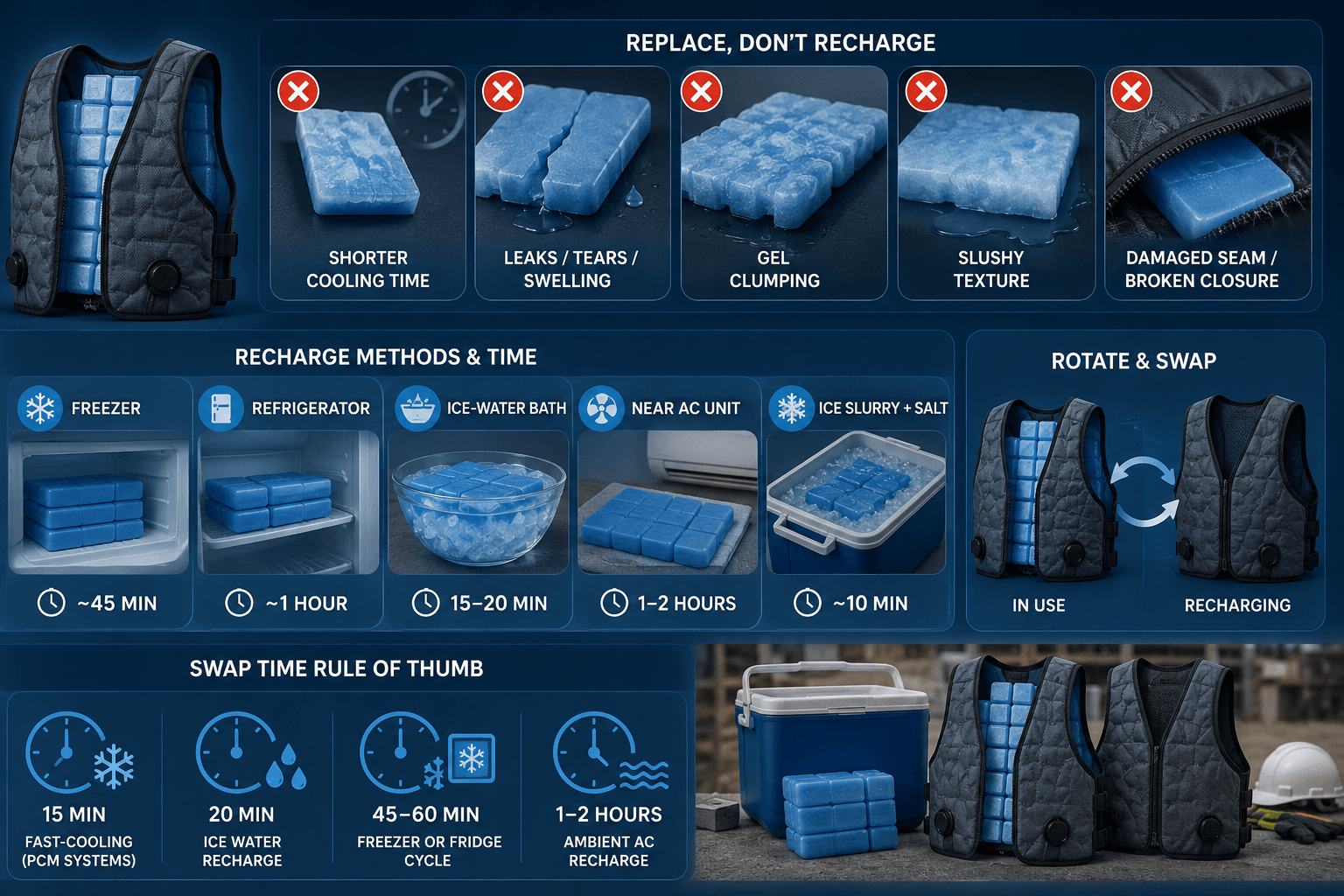
A pack that's barely lukewarm just needs a recharge. A pack that's cracked, leaking, or won't freeze evenly goes in the trash. Getting that call right saves you money and keeps your cooling vest from going dead midway through a shift.
Signs It's Time to Replace, Not Recharge
Retire a pack when you notice:
Reduced cooling time compared to when it was new—same freeze cycle, shorter relief
Leaks, tears, or visible swelling in the pack material
Gel clumping instead of an even, smooth freeze
Slushy texture that won't fully solidify, even after a full freezer cycle
Damaged seams or a broken closure that won't seal against your skin
Any one of these means the pack is done. Keep using it and you're guessing at cooling time instead of counting on it.
Recharge Methods and Real Timeframes
If the pack is intact but just warm, here's how long each method takes:
Freezer: about 45 minutes for standard reusable packs (PCM packs recharge faster, as covered earlier)
Refrigerator: about 1 hour for general cooling packs
Ice-water bath: 15–20 minutes for common gel or standard packs
Near an AC unit: 1–2 hours when no freezer or fridge is available
Ice slurry plus salt: about 10 minutes—handy if your job site or team needs fast turnaround between shifts
The Practical Swap Rule of Thumb
15 minutes = fast-cooling, phase-change systems
20 minutes = typical gel or ice-pack recharge in ice water
45–60 minutes = standard freezer or fridge cycle for most reusable packs
1–2 hours = ambient AC recharge or spacing between recovery sessions
If you're also using packs for injury recovery alongside vest cooling, sports-rehab protocols run shorter, more frequent cycles—15–20 minutes on, every 2–3 hours during the first 24–48 hours after injury. That's a different use case than all-day vest cooling, so don't apply recovery timing to your shift plan.
FAQ: Common Questions About Ice Pack Vest Cooling Time
Real questions deserve real numbers. Here's what people ask before and after they buy.
How cold does an ice pack vest get?
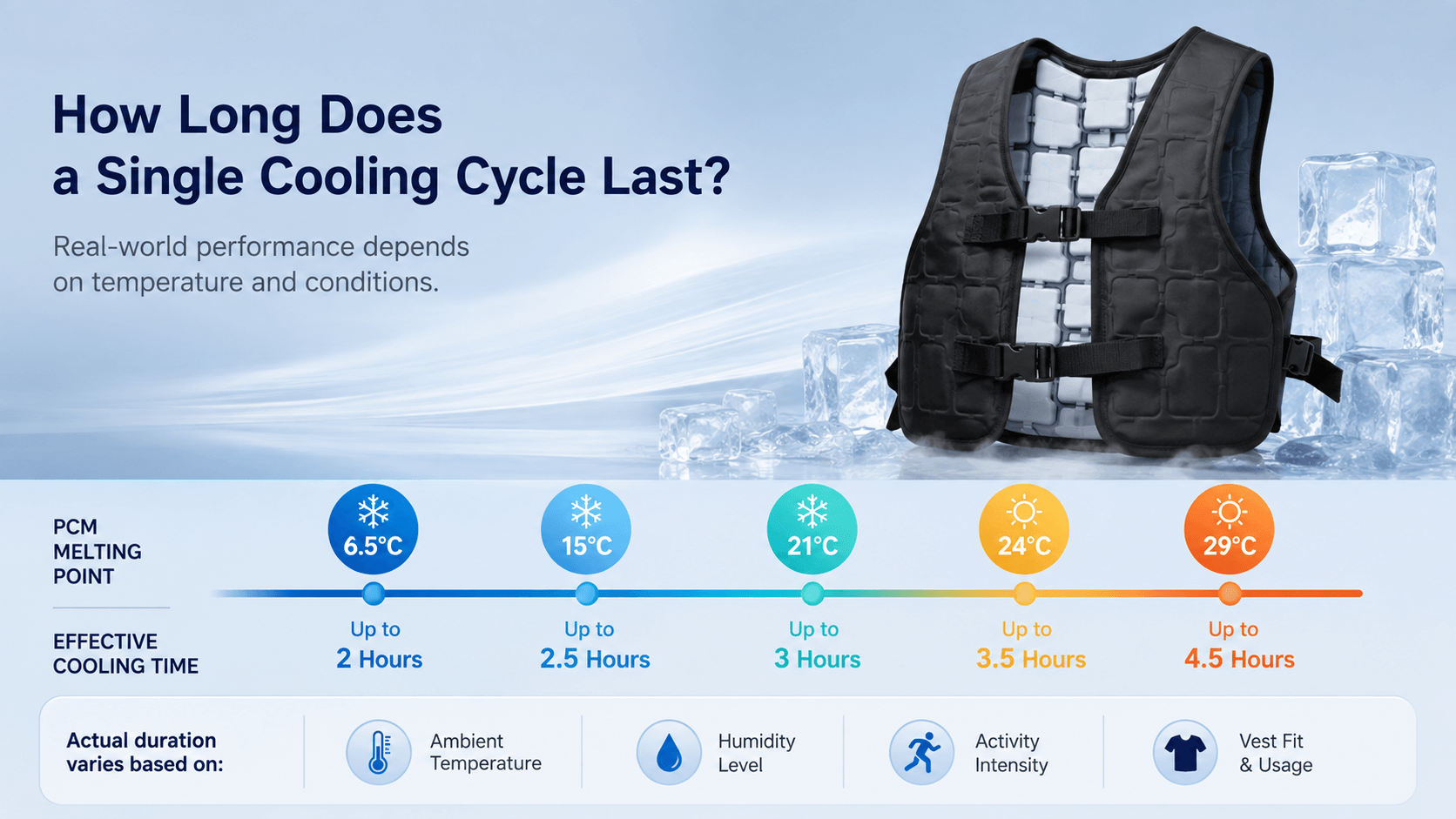
Most gel and PCM vests hold your skin temperature around 53–56°F for up to 3 hours, or a milder 59–65°F for 2.5 to 10 hours, depending on the pack design. One commercial PCM system is spec'd to maintain a steady 64°F (18°C) throughout wear. Melt point drives everything: a 6.5°C pack runs about 2 hours, 15°C stretches to 2.5 hours, 21°C hits 3 hours, 24°C reaches 3.5 hours, and a 29°C pack can push 4.5 hours. Higher melt point, longer runtime, less initial chill.
What's a quick benchmark I can trust?
For basic ice-loaded vests, plan on 60–120 minutes. For PCM designs, 2–4 hours is the standard expectation, with premium packs occasionally stretching further. A vest rated for 3 hours at 35°C often drops to just 2 hours at 40°C in direct sun—heat doesn't negotiate.
Can I swap packs instead of replacing the whole vest?
Yes. Most systems use swappable inserts, and you can recharge the same packs in a freezer or ice water—no need to buy new gear.
Is an ice pack vest good for motorcycle riding?
Prioritize slim, secure-fitting packs. Bulky loaded vests get awkward under riding gear, while lighter PCM options layer more comfortably under PPE.
Why does everyone say ice packs feel colder but PCM lasts longer?
That's the consistent pattern across reviews: ice packs deliver the coldest first blast but fade fastest, while PCM trades a bit of that initial chill for steadier, longer-lasting cooling.
Conclusion
Your Ice Pack Cooling Vest will keep you comfortable for roughly 2-4 hours, but you can actually control that number. Ambient temperature, activity level, and pack thickness all move the needle, and simple habits like proper pre-freezing and rotating a second set of packs can stretch your cooling vest duration well beyond the average.
Your cooling vest is a tool that rewards a little planning. Freeze your backup packs the night before, know your swap schedule, and you'll never get caught sweating through a shift or a run.
Check your current ice packs' condition, grab a spare set if you're a heavy user, and build a simple rotation into your routine.