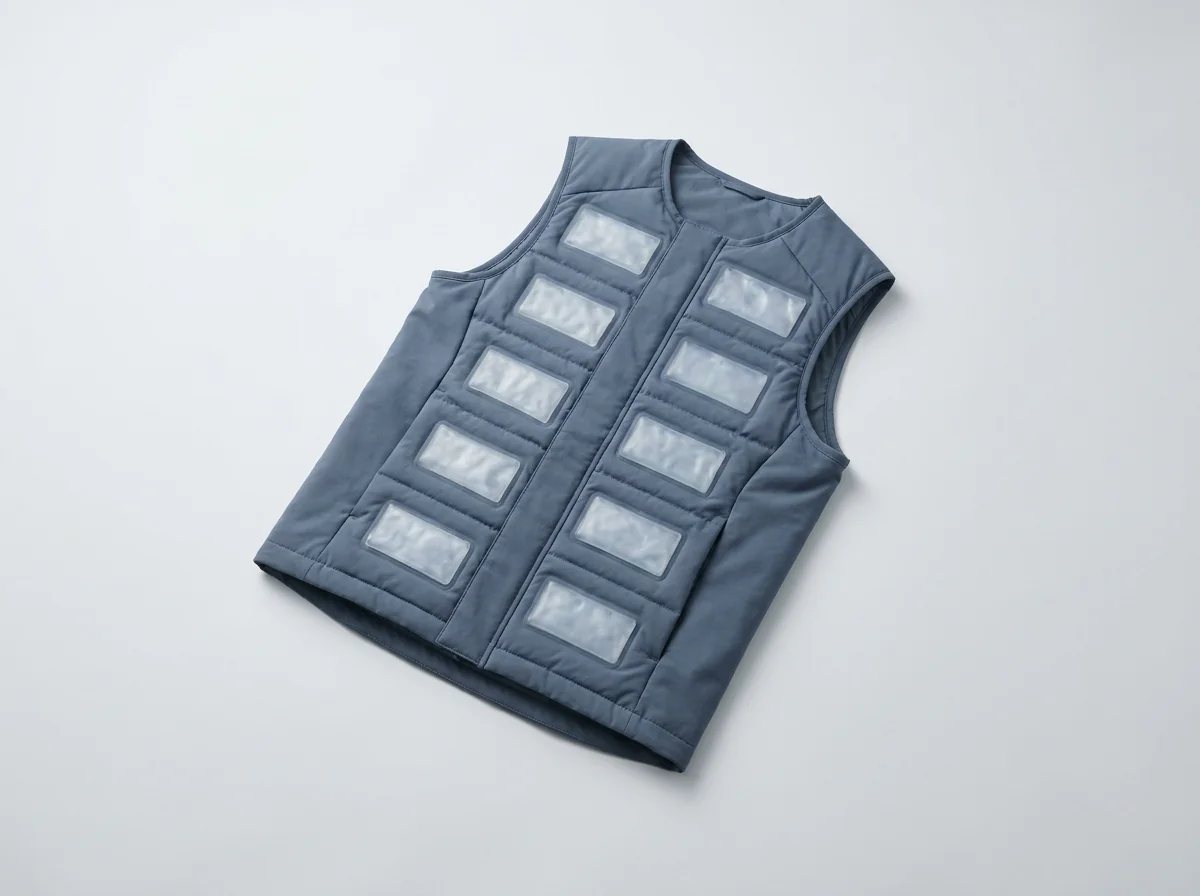
Step outside into 90% humidity, and you'll see why your evaporative cooling vest suddenly feels like a damp, useless towel. That's the frustrating reality for a lot of outdoor workers, athletes, and anyone managing heat sensitivity in tropical or coastal climates. The cooling gear that worked great in dry heat just stops working when the air is already saturated with moisture.
So which technology actually holds up? A PCM cooling vest, or the evaporative kind?
The answer comes down to basic physics. Once you understand how each system pulls heat from your body, the right choice becomes obvious.
Here is a side-by-side comparison of how phase change material and evaporative cooling perform when humidity works against you, and which one to trust for your specific work environment.
How PCM Cooling Vests Work: The Phase-Change Science Behind Dry, Consistent Cooling
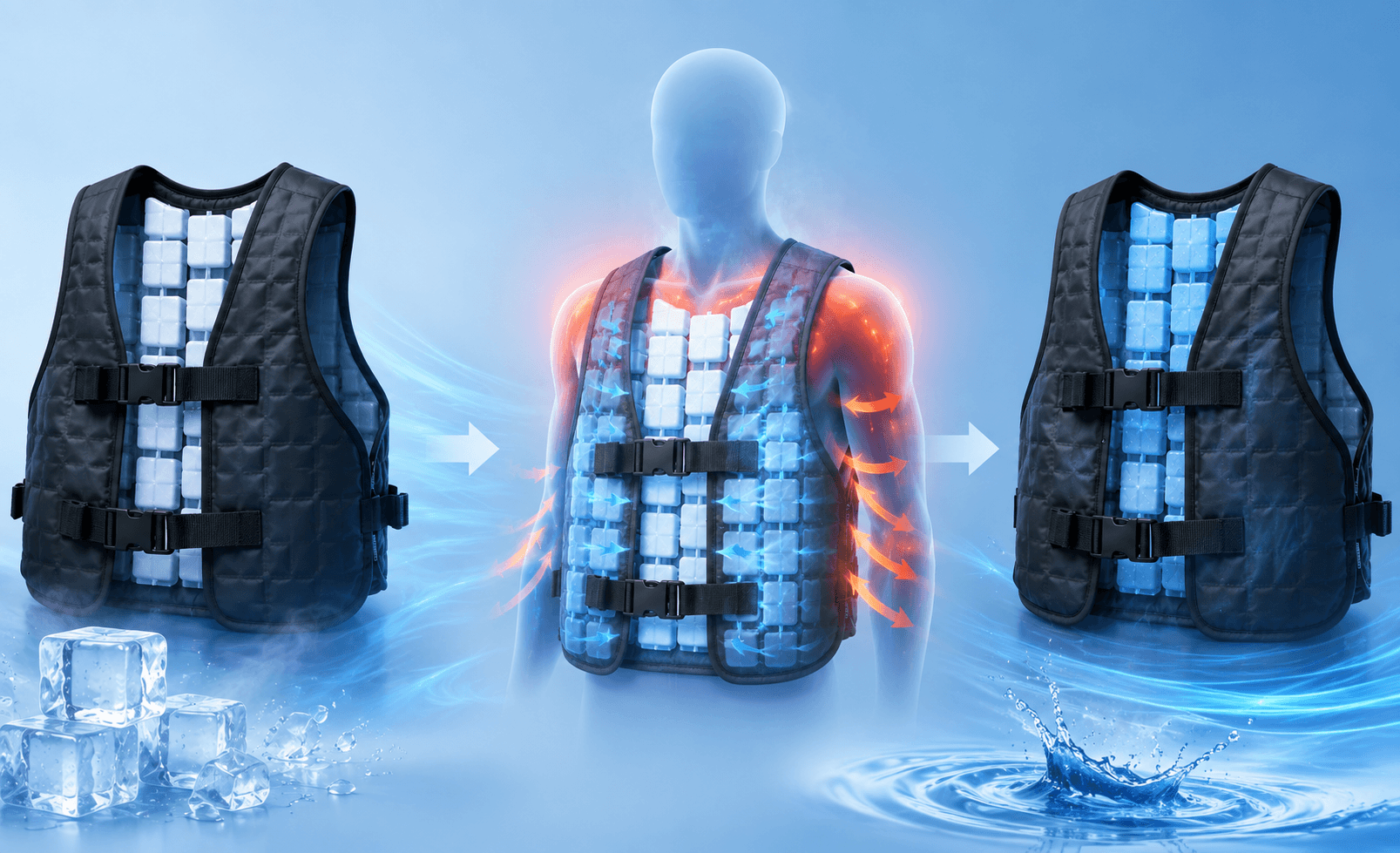
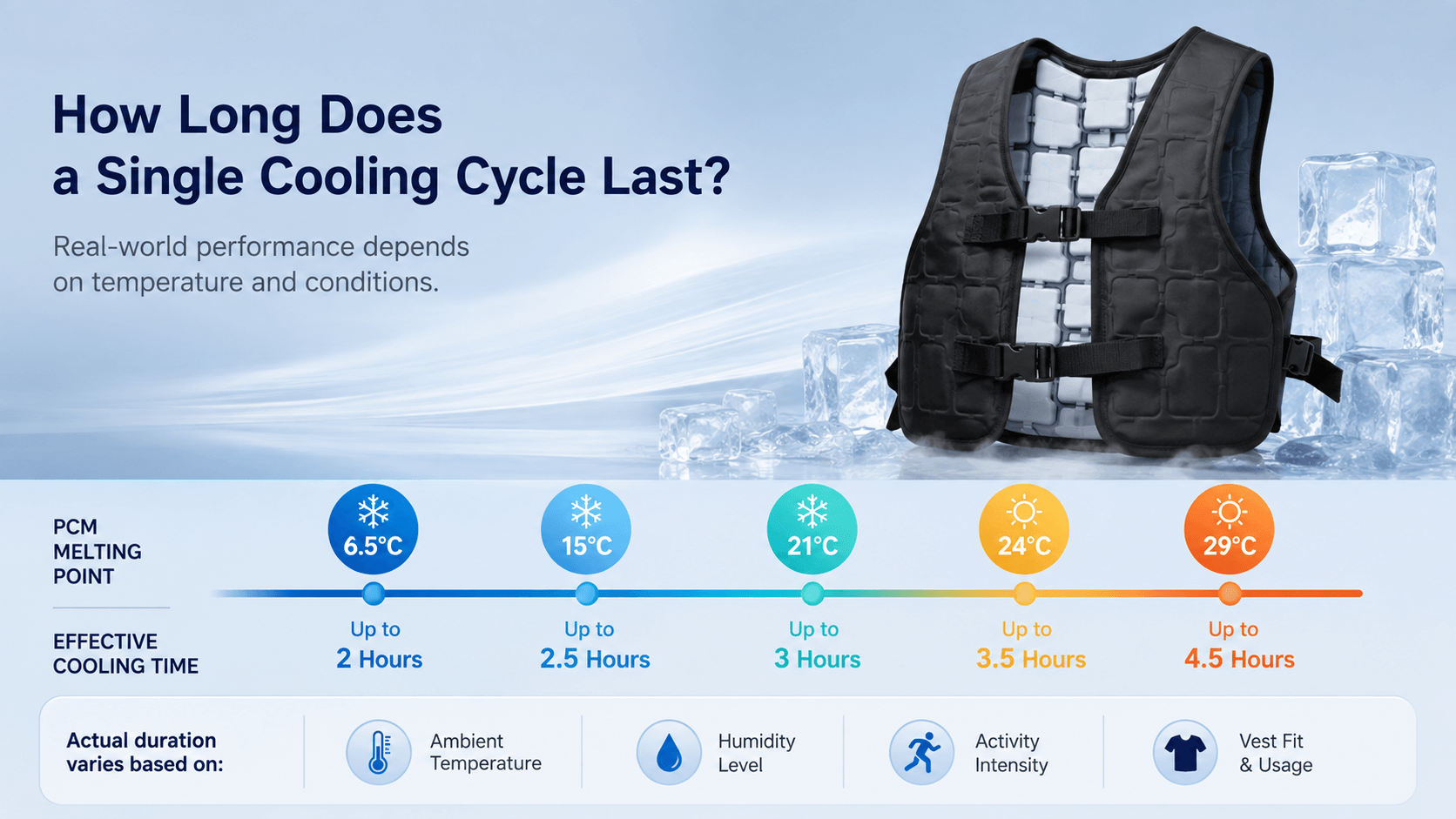
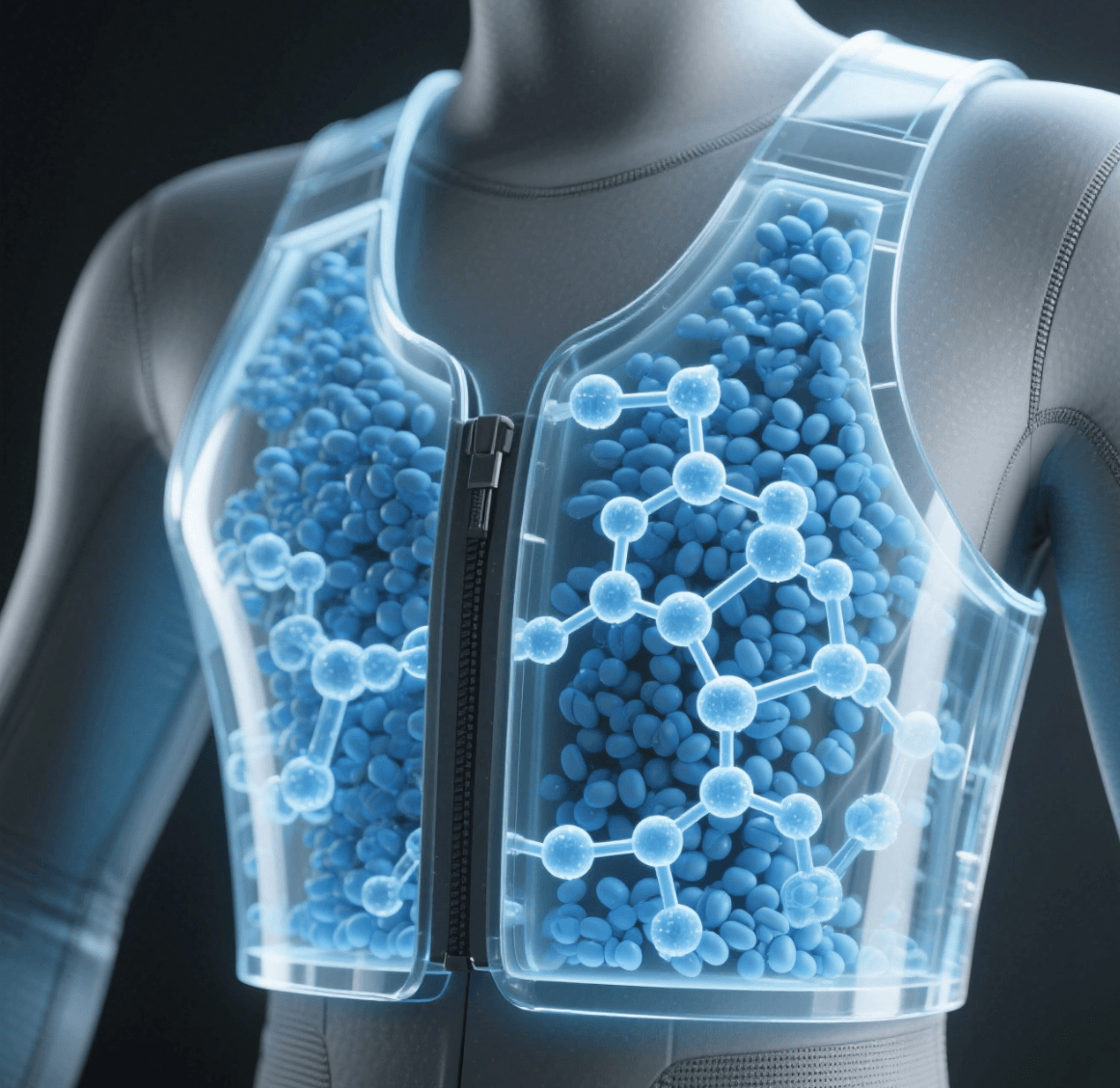
A PCM cooling vest is a wearable freezer pack with a built-in thermostat. Inside each panel sits a phase change material engineered to melt at a specific preset temperature. As that material shifts from solid to liquid, it pulls heat directly from your body, and the vest stays at a steady temperature instead of warming up fast the way ice does. Commercial PCM cooling packs melt somewhere in the 15°C–29°C range, with common options at 15°C, 21°C, 24°C, and 29°C. Some brands push further with a 6.5°C version for intense heat exposure.
This technology doesn't need sweat or airflow to work. The cooling comes from heat absorption during phase change, so humidity, ambient moisture, and PPE layers don't interfere with performance. That's why PCM cooling vests hold up in tropical or coastal climates where evaporative options stall out.
Picking the Right Melt Point
15°C — strongest cooling, best for high heat exposure
21°C — balanced comfort with sustained cooling
24°C — moderate cooling, minimal "cold shock"
29°C — subtle cooling, ideal for warm-but-not-extreme settings
Runtime and What Cuts It Short
Runtime scales with the melt point. A 6.5°C pack runs about 2 hours, a 15°C pack stretches to roughly 2.5 hours, and a 21°C pack can last up to 3 hours. Broader market data puts most PCM vests in the 2–3 hour window, with premium formulations reaching 2–4 hours.
Three things shorten that window fast: higher ambient temperature, higher activity intensity, and wearing PPE that traps body heat. One study found PCM vests performed best in high-humidity, high-heat conditions, but effectiveness dropped in very dry environments where evaporative cooling could have contributed but was restricted by the PCM design itself.
How Evaporative Cooling Vests Work: Why Humidity Is Their Weakness
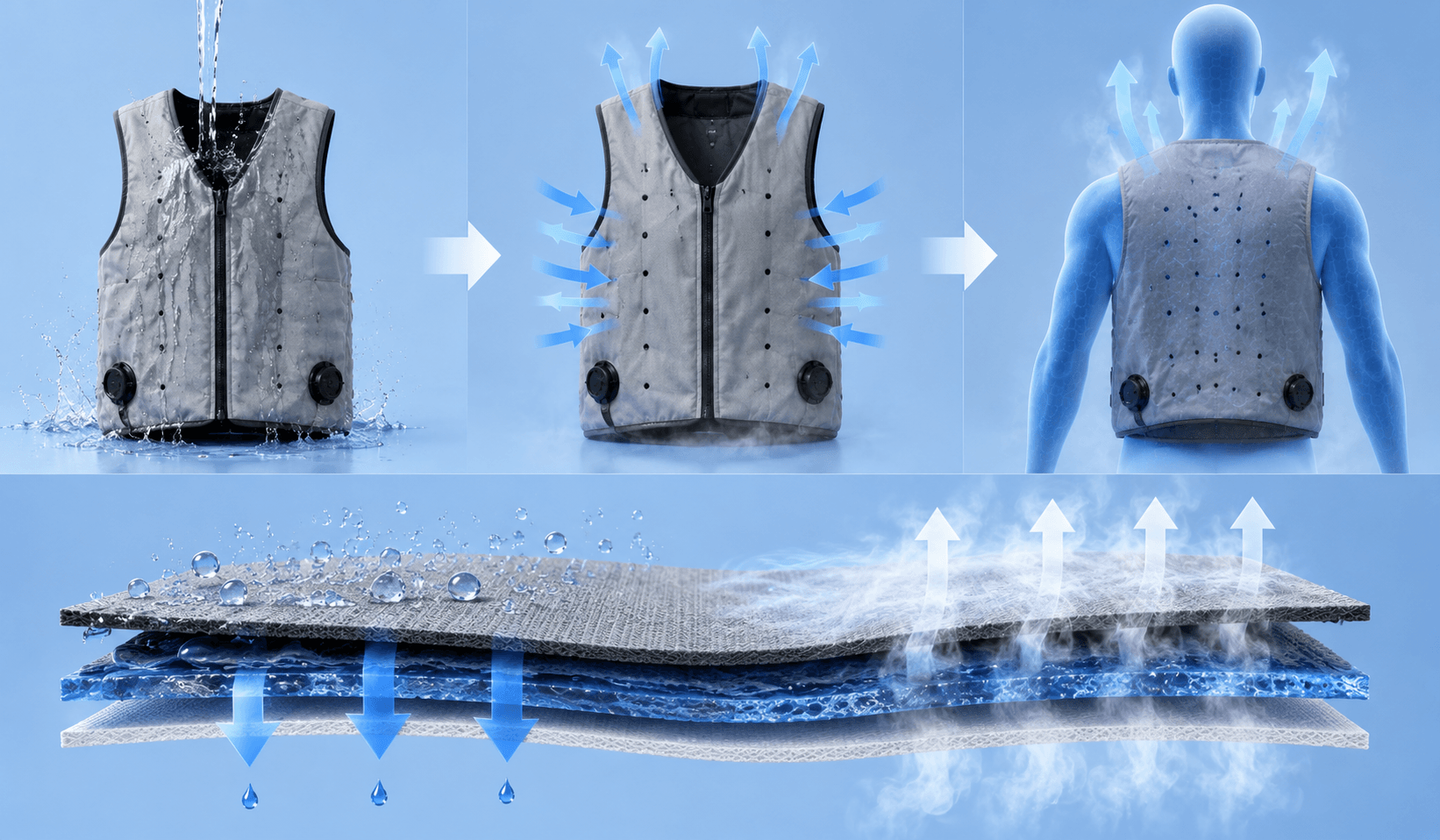
Evaporative cooling tech works on a simple idea: water absorbs heat as it turns into vapor. You soak the fabric, air moves through it, and heat pulls away from your skin when the moisture evaporates. Same principle as sweating, just built into a vest.
Problem is, the whole system needs dry, moving air. Humidity and low airflow suppress evaporation, and the numbers are clear. One study on evaporative vest designs showed that going from 20% to 40% relative humidity at 35°C caused a 28% drop in cooling capacity on average. Another review found bigger losses: cooling power at 30% RH averaged 78 W across different temperatures, but at 60% RH that number fell to 42 W.
The Psychrometric Wall
Here's what's happening physically. Air can only hold so much water vapor before it saturates. As relative humidity goes up, the vapor-pressure gradient between the wet vest fabric and the surrounding air gets smaller. Less water can evaporate, so less latent heat gets removed. Throw in stagnant air, and the vest just sits there, wet and warm.
Industry benchmarks put the effective range for evaporative vests below 40% RH. Above 60% RH, most models lose most of their cooling power. Vest design still matters – some structures deliver twice the cooling capacity of others under the same conditions – but humidity sets a hard ceiling that better materials can't fully break through.
Runtime tells the rest. Evaporative vests last 0.5 to 3 hours before you need to soak them again. In humid conditions, that window shrinks along with the cooling effect itself.
PCM vs Evaporative Vests: Side-by-Side Performance Comparison Table
Numbers settle arguments faster than opinions. Here's the side-by-side data to match a cooling vest to your actual environment.
Metric | PCM Cooling Vest | Evaporative Cooling Vest |
|---|---|---|
Cooling mechanism | Phase-change packs absorb heat at a set melt point; steady, dry cooling | Water evaporation pulls heat from fabric and skin |
Best environment | Humid, indoor, low-airflow, PPE-heavy work | Dry, outdoor, high-airflow conditions |
Humidity sensitivity | Unaffected by ambient moisture | Drops sharply as humidity rises |
Fit under PPE | Handles thick layers and sealed suits well | Struggles without airflow underneath |
Feel | Cool and dry | Cool but noticeably damp |
Duration | 1.5–4 hours typical; some advanced designs run 8–12 hours | 0.5–3 hours per soak |
Recharge method | Freeze or refrigerate the packs | Re-soak with water |
Typical weight | 1.5–3 kg charged | 0.5–1.2 kg |
Price range | $80–$400 | $15–$80 |
The lab data backs up the pattern. In an 8-hour trial, PCM vests extracted a maximum of 164 W·h·m⁻², compared to 113 W·h·m⁻² for evaporative vests. Separate 2025 testing showed PCM packs dropping skin temperature by 3–4°C for up to 120 minutes straight.
If airflow and dry air aren't guaranteed, PCM handles humid conditions better.
Why PCM Outperforms Evaporative Cooling in Humid & Tropical Climates
Researchers tested this exact question in a climate chamber, and the results surprised even the people running the study. At 34°C and 75% relative humidity, three different PCM cooling vests all delivered effective torso cooling. Take those same vest designs into a drier environment, at 34°C and 37% RH, and the cooling benefit actually turned negative. The study concluded that cooling vests “significantly restrict evaporative heat loss” once you’re not relying on evaporation. PCM performs better when the air is thick with moisture, because it was never competing with sweat evaporation in the first place.
The Data Behind the Reversal
Evaporative cooling’s humidity problem shows up in thermal manikin testing. At 35°C and 0.4 m/s airflow, raising relative humidity from 20% to 40% cut evaporative cooling capacity by an average of 28%. Every percentage point of added moisture in the air makes it harder for sweat or a wet vest to release heat.
Hybrid vests that add PCM to the mix tell the other half of the story. In a 3-hour trial at 34°C and 60% RH, PCM-enhanced vests produced roughly 60 minutes of additional cooling over standard designs, with torso cooling power averaging 67 W compared to 56 W for the control vest. That gap doesn’t shrink as humidity climbs. It holds steady, which is the whole point of phase-change tech.
Real-World Tropical Conditions Back It Up
A construction-worker simulation run in a Hong Kong-style climate chamber at 37°C and 60% RH found that PCM-plus-fan cooling vests significantly reduced thermal strain markers: thermal sensation, physiological strain index, and core heat stress scores all dropped. This is the exact profile of coastal construction sites, fishing operations, and Southeast Asian outdoor work: high humidity, low airflow, heavy exertion.
There’s a comfort benefit too. Test subjects wearing PCM cooling garments under PPE reported their subjective humidity discomfort improving from -1.08 to -0.33 at 26°C, and from -1.50 to -0.58 at 32°C. Less “trapped, damp” feeling under sealed layers.
For tropical work cooling vest use cases like shift-long labor, unpredictable airflow, and sealed protective gear, the value proposition is that steady, predictable cooling output you can plan a shift around, not peak cooling power.
Choosing the Right Cooling Vest Based on Your Climate & Work Environment
Here's how to match the cooling vest tech to your actual conditions.
Dry heat, moving air, moderate activity — think desert construction sites, less than 40% relative humidity, temps around 30–40°C. An evaporative cooling vest is the play. Lightweight, cheap to run, easy to re-soak between breaks.
Humid heat, sealed spaces, low airflow — coastal job sites, monsoon season, relative humidity at 60% or higher. Go PCM. At 34°C and 75% RH, PCM vests kept delivering effective torso cooling in testing. Evaporative designs in that same environment stalled out fast.
Long shifts in high heat and high humidity — 8-hour construction days, factory floors. PCM or hybrid vests win. Long-duration trials at 35°C and 35% RH showed hybrid and PCM setups outlasting evaporative options past the first few hours.
Indoor heat sources with poor ventilation — kitchens, foundries, machine rooms, sealed warehouses. PCM cooling packs are the safer bet. Evaporative vests need airflow to function, and industrial indoor spaces rarely have enough of it.
Outdoor, windy, dry, with easy access to water refills. Evaporative wins on cost and weight every time.
Factor In PPE and Activity Level
If you're wearing a safety vest, reflective gear, or sealed coveralls on top, go with a thin, low-profile PCM or hybrid vest. Bulky evaporative vests get crushed under outer layers, which kills airflow and tanks evaporation.
Activity level matters too. Light duty like patrol or inspection work suits evaporative vests fine. High-intensity labor in humid conditions — heavy construction, competitive training, extended cycling — needs PCM's steady output, not a vest that quits when sweat can't evaporate fast enough.
For dry heat and airflow, an evaporative vest. For humid heat and sealed layers, PCM.
Common Questions: PCM Vest Performance, Duration & Real-World Limitations
Buyers asking about a PCM cooling vest almost always land on the same three questions: how long does it actually last, how fast can you recharge it, and what breaks down when you push it past its limits. Here's the straight answer to each.
How long does a PCM cooling vest last? Most standard packs run 1.5–4 hours of active cooling in real work conditions. One documented product benchmark shows 4 hours at 35°C and 3 hours at 38°C for the same vest, just cooler temps buying you more time. Higher-density or advanced PCM systems can stretch to 8–12 hours under lighter-duty conditions, but that's the ceiling, not the norm. In moderate 25–35°C environments, expect somewhere in the 2–8 hour range depending on PCM mass and design.
How fast can you recharge one? Faster than most people assume. Freezer or ice water gets a pack ready in 5–10 minutes. An 8°C fridge takes about 30 minutes. Room-temperature recharge at 22°C runs 2–3 hours. Commercial guidance usually lists 15–60 minutes across fridge, freezer, and ice-water methods.
Once the phase change material fully melts, cooling drops fast. That's the tradeoff for steady, humidity-resistant performance. Fixed runtime means shift workers need a rotation system, not just one vest. Carry 1–2 spare PCM sets, pre-chill them before your shift, and use modular packs so you can swap inserts without pulling the vest off. That logistics step is the price for a PCM cooling vest that keeps working when an evaporative vest gives out in humid air.
Final Verdict: Making a Confident, Climate-Based Cooling Vest Decision
Boil this whole comparison down to one number: humidity percentage. That's the decision point.
RH 60% and above — grab a PCM vest. RH 20-40% — evaporative wins on cost and simplicity. RH 40-60% is the gray zone, where PCM should lead but evaporative can still pull its weight if airflow is solid.
Once you're in PCM territory, melt point matters. Here's the quick split:
28°C PCM packs — general outdoor labor, moderate activity, longer shifts where steady, gentle cooling beats a hard chill.
21°C PCM packs — short bursts of intense heat exposure, when you need a sharper drop in skin temp right now, not a slow burn over hours.
Run the decision in three steps. Check humidity first. Then check your gear setup — sealed PPE and low airflow push you toward PCM regardless of climate. Finally, match runtime to shift length.
Conclusion
In high-humidity environments, the performance of PCM cooling vests and evaporative cooling vests differs significantly. Evaporative vests rely on moisture evaporation to remove heat, making them more effective in dry, well-ventilated environments; however, their cooling capacity diminishes as humidity increases and the evaporation rate decreases.
In contrast, PCM cooling vests do not rely on moisture evaporation but absorb heat through phase change materials during the phase transition process. Therefore, in humid outdoor construction sites, warehouses, underground operations, or other high-temperature, high-humidity environments, PCM typically provides a more stable and predictable cooling experience.
However, this does not mean that PCM is better in all scenarios. When choosing a cooling vest, factors such as ambient temperature, relative humidity, workload, wearing time, and the reactivation conditions of the PCM pack should be considered. In dry environments, lightweight and easily rehydrated evaporative vests are preferable; in high-humidity environments, PCM is a better choice.
If you're still comparing PCM Cooling Vests versus Evaporative Cooling Vests, you can visit ICEBEARCARE to view more products and cooling technology guides, and choose the most suitable solution for your actual working environment.
For industrial high-temperature operations, outdoor work, or projects requiring long-term thermal management, you can also contact ICEBEARCARE to match a more suitable Cooling Vest based on specific temperature and humidity, PPE wear, and usage duration.