A shipment of 5,000 PCM cooling vests sitting in a customs warehouse can wipe out an entire quarter's profit. Yet every year, buyers sourcing phase change material cooling vests for the US and EU markets get blindsided by the same compliance gaps: missing CE marking for PPE, incomplete REACH testing documentation, or assuming FDA rules don't apply because "it's just a cooling vest."
They apply. And the certification maze differs sharply depending on which side of the Atlantic your buyer is shipping to.
Before placing a PO, US importers and EU distributors need to verify everything from EN 342 standard requirements to OEKO-TEX certification, plus the five certification mistakes that get containers flagged at port, and how to vet whether your supplier's paperwork is real or recycled from a catalog.
Do Cooling Vests Need FDA Approval to Enter the US Market?

It depends entirely on what your marketing copy says. The FDA regulates claims, not cooling vests as a category. Sell your PCM cooling vest as "treats heat stroke," "therapeutic," or "medical-grade," and you've just self-classified it as a Class I medical device under 21 CFR Part 890. That triggers FDA device pathway requirements you probably weren't budgeting for.
The safer commercial lane is to position your product as a non-medical cooling garment or workwear-grade personal protective equipment. Most PCM cooling vests sold into construction, warehousing, and outdoor labor markets stay in this lane, with no FDA device claims and no device classification headaches.
Instead, buyers check for these:
- OSHA doesn't certify vests, but expects third-party heat-stress test reports
- ASTM F2371 for any cooling-duration or thermal-performance claim, tested on the exact SKU, not a generic material cert
- ANSI/ISEA 107 if selling as high-visibility safety apparel
- CPSIA compliance apparel rules if the vest targets children, with lead limits (100 ppm), surface coatings (90 ppm), and phthalates (0.1%)
If you get the claim wrong, a recall is your first problem.
What Certifications Trigger CE Marking Under EU PPE Regulation 2016/425?
The moment your product description says "protects against cold" or "reduces occupational cold exposure," you've stepped into Category II PPE territory under Regulation 2016/425. Sell the same vest as lifestyle apparel with zero safety claims, and CE marking for PPE never enters the conversation. The classification depends on your marketing language and intended use case.
Which Standard Applies Depends on Temperature Range
Two harmonized standards govern cold-protection garments, and mixing them up is a common paperwork error. EN 14058 covers cool environments above -5°C, mostly indoor use. EN 342 covers cold environments below -5°C, built for harsher exposure.
A PCM cooling vest marketed for warehouse work in mild climates likely falls under EN 14058. One rated for outdoor cold-weather labor needs EN 342 testing instead.
The Certification Flow Itself
The fixed sequence for Category II PPE is Module B, Module C, CE marking, and then the Declaration of Conformity (DoC).
Module B is the EU-type examination. Your supplier submits a Technical File — product specs, materials, test reports, risk assessments — to a Notified Body registered specifically for cold-protection PPE. Pass, and you get an EU type-examination certificate.
Module C covers production control after approval. The manufacturer confirms ongoing output matches the certified type, then affixes the CE mark and issues the DoC.
That DoC should list the manufacturer, product type, the regulation cited, harmonized standard used, Notified Body number, and Module B certificate reference. Missing any of these fields is a red flag your supplier's certification is incomplete or fabricated.
REACH Compliance for PCM Cooling Vest Materials: What Buyers Must Verify
A signed "REACH compliant" letter from your supplier is worth almost nothing on its own. You need three separate document types, not one generic statement.
The Three Documents That Matter
A third-party lab report must name the exact PCM material or component, test date, lab name, and measured substance levels. A pass/fail summary alone proves nothing.
A supplier REACH declaration must cite the current SVHC Candidate List version and date, scoped to your specific product. The list updates twice a year, so anything older than that loses value fast.
An SDS or material disclosure is helpful for identifying components, but it never replaces lab data on the finished vest assembly.
What Gets Tested, and Where Vests Fail
If any component contains an SVHC above 0.1% w/w, disclosure is mandatory, and consumer response is required within 45 days. Watch for:
Phthalates in coatings, PVC pockets, and straps. The DEHP benchmark is 1000 mg/kg.
Formaldehyde in fabric and coatings. Typical limits are 75 ppm for adults and 16 ppm for children.
Heavy metals like cadmium, mercury, and extractable metals in trims and textiles.
The Real Failure Point
Suppliers often send a report covering standard fabric while skipping the PCM film, pouch coating, or adhesive. This leaves a gap. Request a full bill-of-materials test scope, confirm the report matches your exact article version, and reject anything older than 12 months. For EU retail buyers, an OEKO-TEX Standard 100 certificate adds commercial credibility with German, Dutch, and Nordic distributors, though it supplements REACH evidence rather than replaces it.
5 Common Certification Mistakes That Get Cooling Vest Shipments Rejected
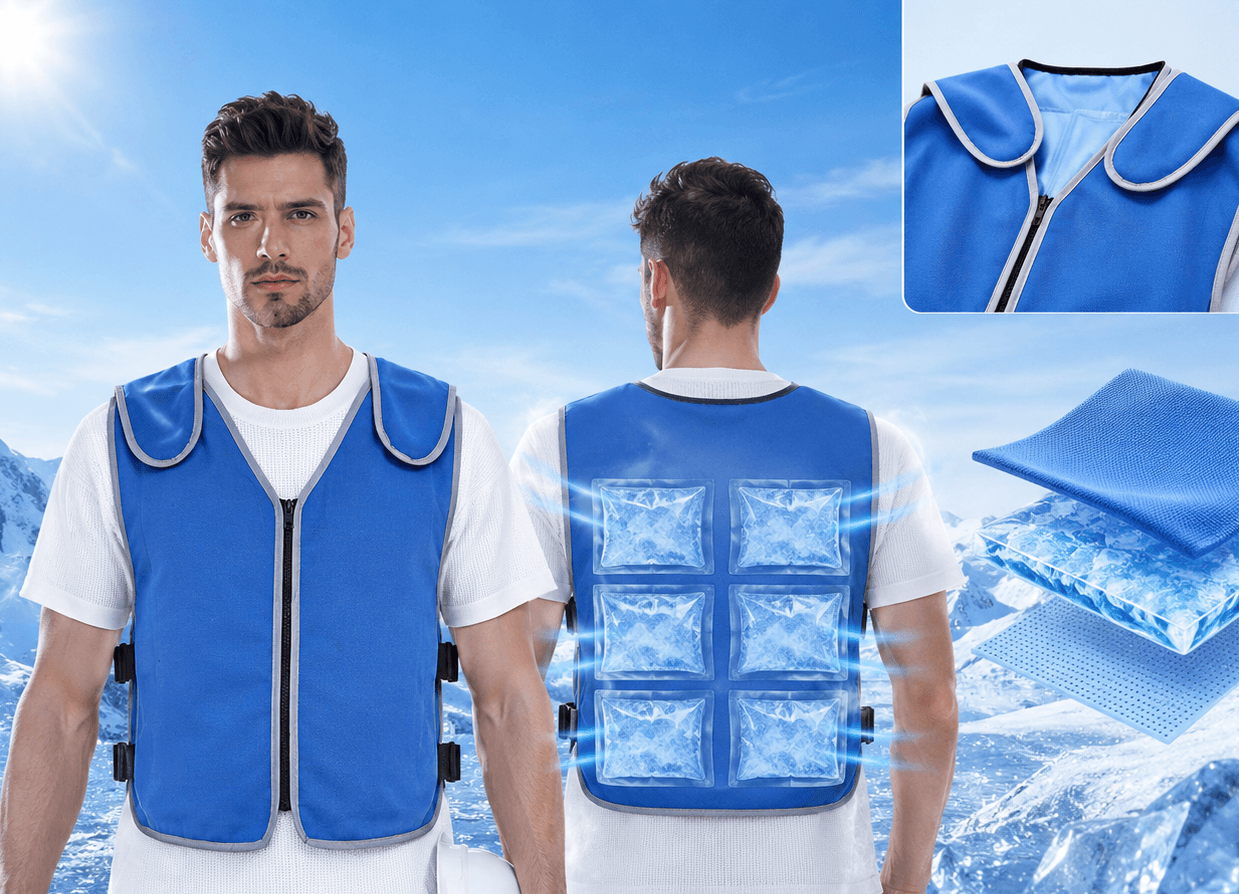
Customs officers read documents. Most rejected shipments trace back to the same five gaps, repeated across suppliers, seasons, and container loads.
Mistake 1: Treating CE as a sticker. CE marking for PPE follows a full conformity route tied to risk category. Category I uses internal production control; category II demands EU type-examination by a notified body; category III adds ongoing surveillance, and its CE mark must carry the notified body number. Skip a step, and the mark means nothing.
Mistake 2: Confusing REACH compliance textile testing with market access. REACH is a chemical-safety layer. It does not substitute for PPE conformity, passing REACH does not give you CE marking. Buyers need both, checked separately.
Mistake 3: Waving USDA BioPreferred around as a safety credential. USDA BioPreferred is a biobased-content label, USDA requires products to hit at least 25% biobased content in most categories outside its named lists. That percentage says nothing about thermal performance or PPE safety.
Mistake 4: Accepting a supplier's word without the paper trail. A signed statement is not evidence. Demand the EU type-examination certificate, the technical file, and correct CE marking details before the PO closes.
Mistake 5: Shipping without the full documentation package. A logo on the label is not compliance. Customs wants the conformity route, technical dossier, and certificate chain matching the exact SKU.
Pre-Shipment Checklist
- CE marking present on every applicable unit
- Correct risk category documented
- EU type-examination certificate for Category II/III
- Notified body number visible where required
- REACH review filed separately from PPE paperwork
- Biobased claims verified by actual percentage, not assumed
Buyer Due-Diligence Checklist: How to Verify a Cooling Vest Supplier's Certifications
Paperwork lies, match it against reality before you wire a deposit.
Cross-Check These Four Items
The model name on the CE certificate, the DoC, the product label, and the actual photos must match exactly. Run the notified body number through the EU's official database — confirm it's approved for PPE certification under Regulation 2016/425. Then check EU Safety Gate for recall history on that SKU.
Factory Verification, Not Marketing Claims
Pull the ISO 9001 certificate. The scope should name PPE, textile assembly, or cooling vest production. A vague "garment manufacturing" scope is weaker evidence. Ask for the latest third-party audit summary and confirm it lists the same legal entity and address as your PO.
Ask These Directly
Which harmonized standard does this exact model cite?
Category I, II, or III under EU 2016/425?
Any material changes in the last 12 months that required re-testing?
A strong supplier pack includes the DoC, notified-body evidence, REACH declaration, ISO 9001, and matching test reports. A weak pack is a brochure with "CE approved" typed on it.
PCM Cooling Vest Manufacturer Certification Comparison
What to look for in a reliable supplier? Two certification tracks cover most reliable suppliers. Knowing which one you're looking at keeps you from comparing apples to oranges.
Track one is PPE and market-access focused. You get CE marking plus standard-specific test reports like EN ISO 20471 (high-visibility) or ANSI/ISEA 107, along with a clear intended-use declaration. This one fits export shipments and jobsite high-vis applications.
Track two is compliance and systems focused. It includes REACH compliance textile documentation, ISO 9001, ISO 14001, and sometimes USDA 100% bio-based claims. This track works for buyers who care about chemical safety, supply chain stability, and sustainability sourcing.
Real Supplier Certification Combinations, Side by Side
CE + EN ISO 20471 + EN ISO 11612 + ANSI/ISEA 107: IceBearCare states its PCM cooling vests come standard with CE marking across all versions, and provides matching EN ISO 20471, EN ISO 11612, and ANSI/ISEA 107 test reports on request.
REACH + USDA bio-based
REACH + ISO 9001 + ISO 14001: A common factory-level bundle. Confirms REACH compliance backed by system-level quality and environmental management, without a PPE market-access claim attached.
The Core Documents That Actually Matter
Document | What to Verify |
|---|---|
CE Declaration of Conformity | Tied to the exact model, not a generic template. Standard number, signature date, model number present |
EC Type Examination Certificate | Issued by a NANDO-listed Notified Body. Check the certificate number and status |
Technical File | Product description, drawings, design calculations, test reports, risk assessment, standards applied, corrective actions. EU authorized rep should produce it within 3 days |
Third-party test reports | Coverage matches target-market standards (EN ISO 20471, ANSI/ISEA 107, EN ISO 11612). Model number matches your PO |
REACH documentation | Supplier declaration, material compliance files, third-party chemical testing where relevant, especially for PCM and skin-contact materials |
System certificates | ISO 9001 and ISO 14001. Check certificate number, scope, issuing body, validity |
A Simple Scoring Framework for Comparing Suppliers
Certification completeness — 40 points: Does the supplier cover your target market (CE, REACH, ANSI, ISO, USDA)? Is the certificate scope specific to cooling vests and PPE materials, or is it vague industry-wide language?
Third-party verification — 25 points: Is the certifying body an actual Notified Body, or a verifiable third-party lab? Can you check certificate numbers, report numbers, and validity dates?
Batch consistency — 25 points: Can they show incoming inspection, in-process inspection, and outgoing inspection records? Does the material spec (PCM formula, fabric, stitching) stay stable across batches?
Traceability — 10 points: Can raw materials, test batches, production batches, and labeling all be traced back and matched?
Checking Icebearcare Against This Framework
Icebearcare's public materials reference CE and RoHS compliance, which signals at least a baseline awareness of EU market requirements. Buyers should push for more: the specific model's CE DoC, Notified Body reference, REACH material declaration, ISO 9001 and 14001 certificates, and third-party test reports, all matched to the same PCM cooling vest SKU. If the product is marketed for high-visibility use, request the EN ISO 20471 report specifically. If it's positioned for protective workwear, ask for EN ISO 11612 or the relevant PPE standard instead.
Quick Rules for Sorting Suppliers Fast
ISO 9001 alone, no product testing: proves management systems, not cooling vest compliance
REACH alone, no CE or test reports: proves chemical safety, not PPE market access
CE claimed but no NANDO-searchable Notified Body record: high risk, re-verify before ordering
Full CE package + test reports + ISO 9001 + REACH: the safest baseline for B2B bulk sourcing
FAQ: Cooling Vest Export Certification Questions Buyers Ask Most
Buyers ask the same six questions on every sourcing call. Here are straight answers.
Is CE the same as FDA? No. CE is EU market access tied to PPE/textile standards. FDA governs US medical claims. A standard workwear cooling vest doesn't need FDA approval — it needs REACH and CE if it's heading to Europe.
EN 14058 or EN ISO 20471 — which one? Different risks, different standards. EN 14058 covers cool-environment protection above -5°C. EN ISO 20471 covers high-visibility safety apparel. Neither replaces the other. Some jobsite vests carry both.
How long does REACH testing take? Standard textile chemical screening runs 5–10 working days. Add SVHC re-testing or complex multi-material components, and expect 10–15 days.
What does REACH cost? Small textile/apparel chemical testing runs a few hundred to a few thousand USD, scaling up with material complexity.
Do I test the whole vest? No — labs test by component: fabric, coating, PCM film, reflective strips, print, trims.
How do I verify a lab report is real? Confirm ISO/IEC 17025 accreditation, cross-check the report number against the lab's own database, and match the standard version — EN 14058 currently sits at 2017+A1:2023, so flag anything older.
Conclusion
Exporting PCM cooling vests to the US and EU comes down to paperwork. A container that clears customs moves to your buyer. One that doesn't sits in a warehouse while demurrage fees pile up and your buyer walks away.
The certifications matter more than the fabric technology. CE marking under PPE Regulation 2016/425 gets you into Europe. Answer FDA classification questions before you ship, not after. REACH compliance testing on your PCM inserts protects you from a recall that ends distributor relationships permanently.
The suppliers who've done this work—who can hand you CE certificates, REACH test reports, and OEKO-TEX documentation without scrambling—are the ones worth building a long-term sourcing relationship with. IceBearCare has already cleared that bar.
Vet your supplier's certification paperwork before you place the order, not after customs calls.