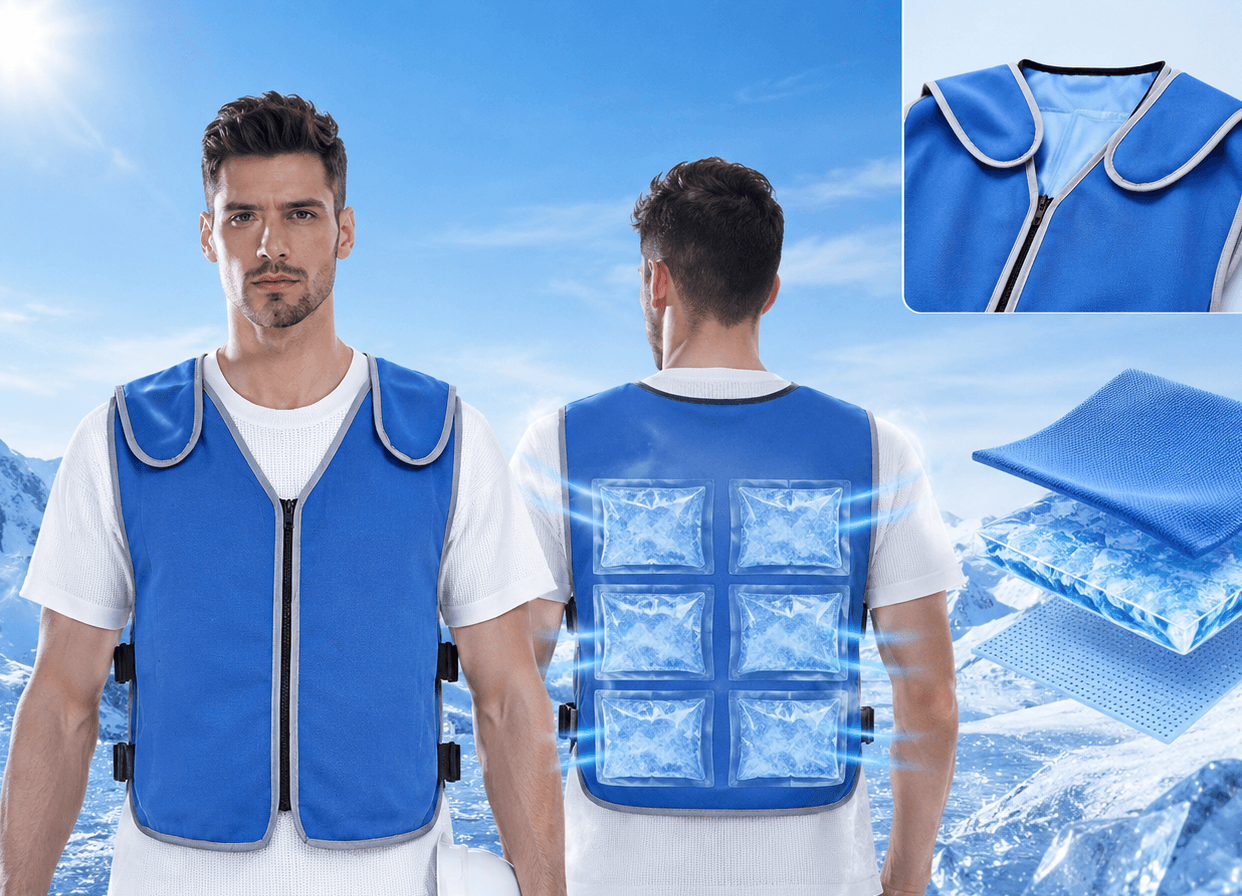
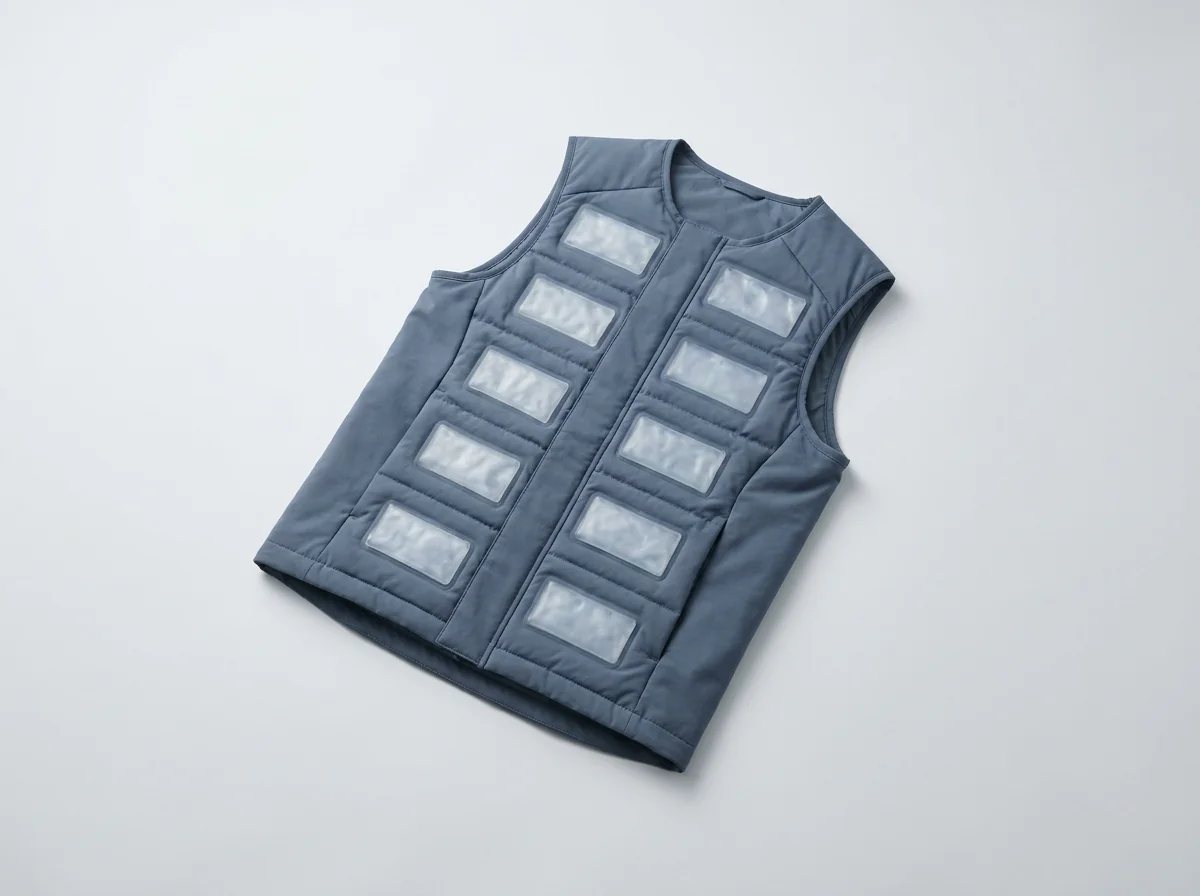
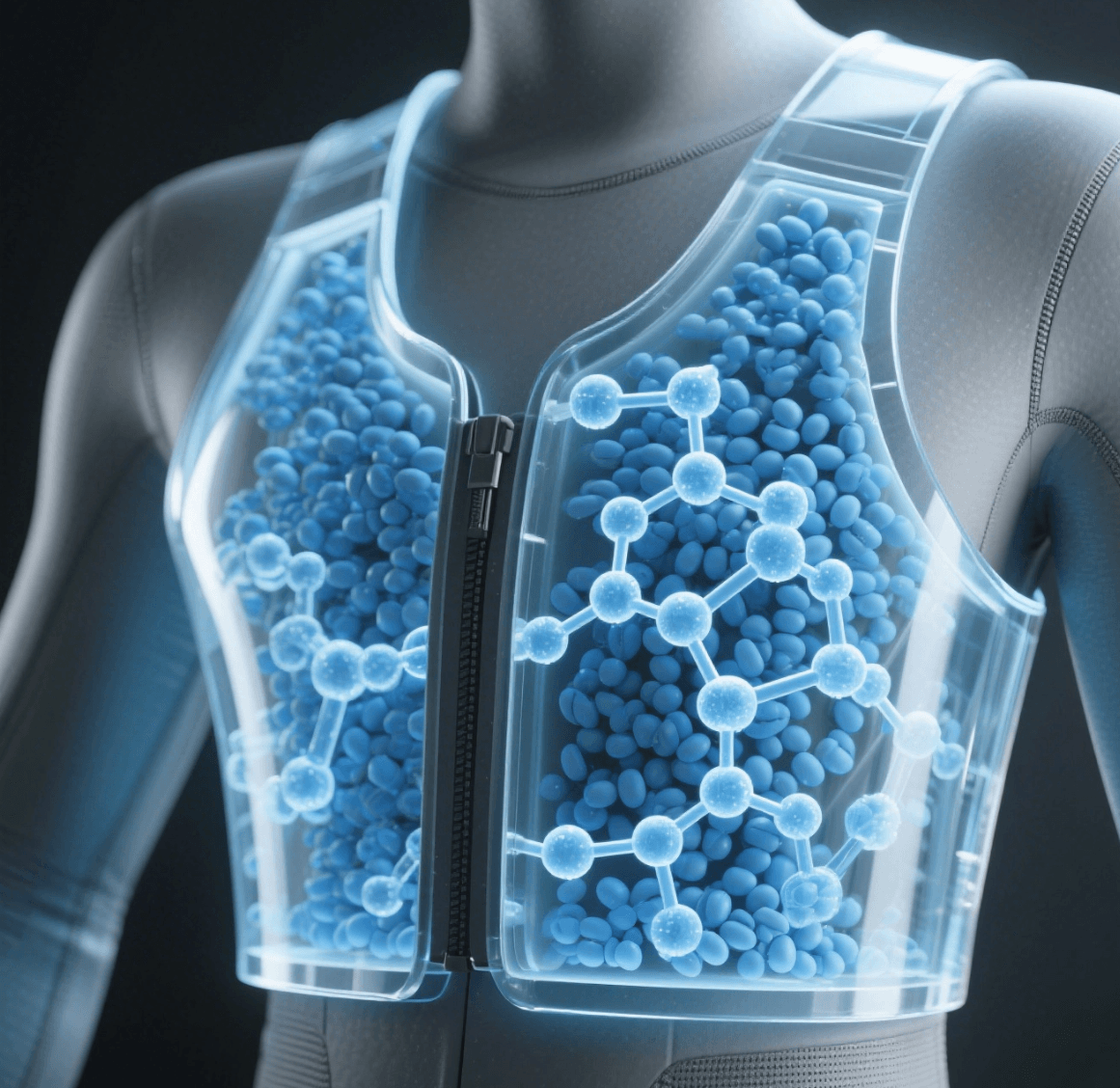
When a European medical cooling brand posts significant sales growth for its cooling vest line, it's because a growing number of people dealing with real thermoregulation issues—multiple sclerosis heat sensitivity, menopause hot flashes, hyperhidrosis—are finally finding relief through properly engineered phase change material cooling technology backed by medical credibility.
The growth signals where the personal cooling device market is heading, and it shows what separates a clinically-validated PCM cooling vest from the evaporative cooling vest you'll find on Amazon for $20. If you're trying to figure out which one actually works for your situation, that distinction matters.
Market Signals Behind the Brand's Sales Growth
Numbers tell a clearer story than any press release. The global cooling vest market sat at roughly USD 215 million in 2024, with projections pushing it to USD 385 million by 2033—a CAGR of about 6.7%. A more conservative estimate puts 2024 figures at USD 64.83 million, climbing to USD 92.2 million by 2031 at a 4.5% CAGR. Either way, the trend line points up.
Where the Real Growth Is Hiding
The broader market growth is steady, but PCM cooling technology is where things get interesting. The phase change material cooling vest segment alone is projected to move from USD 400 million in 2025 to USD 800 million by 2034, growing at 6.8% CAGR. Reusable products already account for 62.4% of that segment.
Two sub-verticals are outpacing everything else:
Medical applications: growing at 9.1% CAGR, driven largely by MS heat sensitivity management and chronic condition care
Sports applications: growing at 8.6% CAGR, tied to performance and recovery use cases
North America holds 42.5% of the thermal comfort wearable market, Europe follows at 28.2%, and cooling vests specifically represent 15.8% of that category. This product has outgrown its "niche accessory" label.
Why This Matters for European Brands
Export data backs up the expansion narrative. German brand Pervormance has already pushed into Switzerland, the US, South Korea, South Africa, and Japan. European medical cooling brands can scale across borders when the product credibility holds up.
Three forces are driving this: rising heat stress from climate shifts, expanding medical demand for thermoregulation wearable solutions, and growing interest from menopause hot flashes cooling and hyperhidrosis cooling solution seekers who want discreet, everyday relief rather than industrial-grade gear. Sales spikes tend to cluster around heatwave season, medical conference cycles, and the 6-12 month window after entering a new regional market.
Medical-Grade Cooling Vests vs Consumer Cooling Products: The Core Differences

The real standard for "medical-grade" is whether a product has human trial data. A study on 16 spinal cord injury participants showed PCM cooling vest effectiveness varied by injury level and torso skin coverage. The low-thoracic group had significant reductions in core temperature rise. That kind of evidence separates a legitimate medical cooling brand from a novelty gadget.
The Physics That Actually Matter
PCM cooling technology absorbs heat during a phase change at a specific melting point. It needs no water, makes no noise, and works in dry or enclosed environments. Evaporative cooling vests rely on moisture evaporation, so humidity kills performance fast.
Real-world tests bear this out. In high-humidity, high-heat conditions PCM vests delivered effective torso cooling. In high-heat, low-humidity settings the cooling benefit turned negative: the vest trapped heat that would have evaporated naturally. Environment dictates outcome.
Duration matters too. PCM vests deliver 3–4°C skin temperature reduction for roughly 120 minutes before requiring reactivation.
Material Safety Separates the Tiers
Consumer ice vests use cold packs that risk overcooling and skin discomfort. Medical-grade PCM designs typically use TPU-encased inserts (some studies reference 36-panel configurations) for even, gradual heat release—critical for anyone managing MS heat sensitivity or hyperhidrosis who needs a long-term cooling solution.
Three questions worth asking before you buy: Does the brand cite human trial data? Do they specify PCM melting point and coverage area? Do they report skin comfort outcomes, not just "feels cool"?
Who Needs a Cooling Vest: Target Audience and Use Case Breakdown

Not everyone buying a cooling vest has the same problem. Matching the right technology to the right condition matters more than chasing the lowest price tag.
Multiple Sclerosis Heat Sensitivity: The Clearest Clinical Case
MS patients dealing with heat sensitivity are the strongest documented use case for cooling vests, full stop. In a crossover-controlled study, MS patients wearing a cooling vest saw walking time to fatigue jump from 1,399±404 seconds to 1,896±602 seconds – a 36% improvement. Walking distance climbed from 1,302±318 meters to 1,879±539 meters, roughly 44% further. Six-minute walk test results showed similar gains, with the biggest distance improvements showing up in minutes five and six, precisely when heat-sensitive patients typically lose speed. A separate randomized trial involving 43 heat-sensitive MS patients found improvements across 10-meter walks, 30-meter walks, TUG tests, single-leg stance, and even subjective fatigue, spasticity, and balance. If the goal is extended walking duration and reduced heat-triggered fatigue, this is where the evidence is strongest.
Menopause Hot Flashes Cooling: A Different Metric
Menopausal women need symptom relief, not performance gains. One cool therapy study using a cooling bolero cut hot flash frequency from 7.23 episodes per 24 hours to 3.4 by week four. Nighttime cooling devices showed self-reported sleep improvement and reduced insomnia. Success is measured in hot flash frequency and sleep quality, so the product profile shifts toward compact, quiet, nighttime-friendly designs.
Outdoor Workers and Athletes: Heat Stress vs. Performance
Construction and outdoor workers care about heat stress management, shift duration, and PPE compatibility – lightweight vests with replaceable coolant that fit under a hard hat and tool belt. Athletes want pre-cooling before events, extended heat tolerance, and reusable PCM inserts that don't restrict movement, with cooling-driven duration gains in similar heat-sensitive studies reaching 33-35%.
Breaking Down This European Brand's Core Competitive Advantages
Clinical trust, technology positioning, and price anchoring form the backbone of this European brand's strategy. E.COOLINE built its case around passive cooling waistcoats.
Clinical Backing Beats Marketing Claims
Continuity is the strongest proof point. E.COOLINE's site states plainly that "for several years now, the Judendorf Clinic has been using" their product for MS patients. No published case count or trial design has been disclosed. But sustained clinical use inside a real treatment setting carries more weight than any 5-star Amazon review. The US National MS Society's approved equipment list includes Glacier Tek, Polar Products, StaCool Vest, and ThermApparel. That kind of institutional approval is the benchmark competitors aim for.
Technology Positioning as Differentiation
Competitors split into camps. Polar Products uses circulating cool water vest systems. StaCool bundles replaceable ThermoPaks. ThermApparel makes concealable, lightweight builds. E.COOLINE stays with passive wear, which means no pumps, water lines, or bulk. That simplicity is a deliberate choice for people who manage MS heat sensitivity daily.
Cooling Vest Buying Guide: How to Avoid Common Pitfalls
Most buying mistakes happen before checkout. People skim a product title, see "cooling vest," and assume every SKU performs the same, but they don't.
Check the Certification
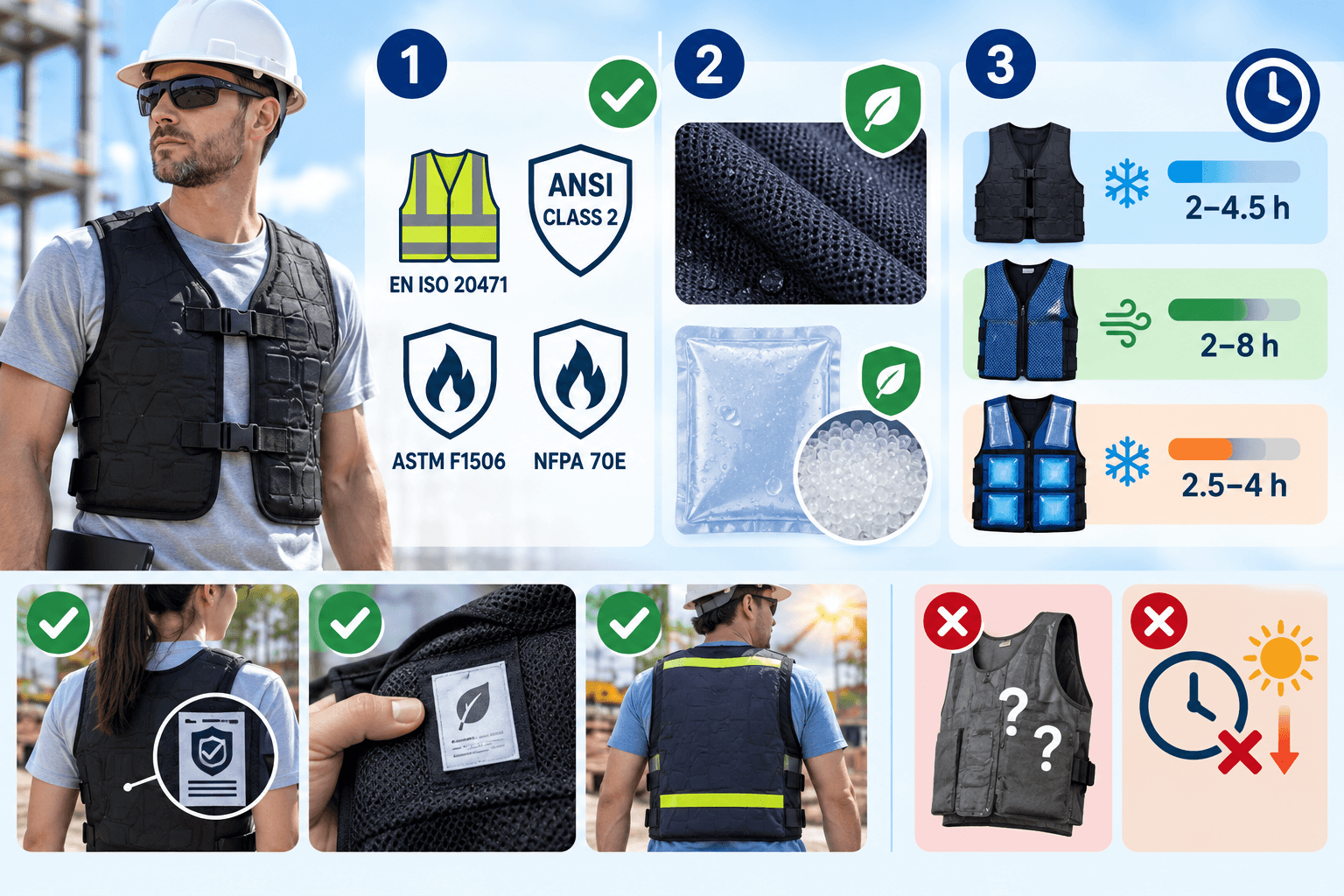
High-visibility work environments need EN ISO 20471 or ANSI Class 2. Industrial protective gear should carry ASTM F1506 or NFPA 70E. If a listing claims specific cooling duration or heat stress relief, ask for a test report tied to that exact SKU. A generic material spec sheet won't do.
Material Safety Isn't Optional
Reliable builds use 100% polyester with PU coating, FR cotton or modacrylic cotton blends, TPU water bags, or PP caps. PCM cooling technology products should label non-toxic PCM explicitly. Before wearing anything against skin daily, confirm skin-contact safety documentation and washing instructions.
Real-World Duration Varies by Technology
PCM cooling vests last 2–4.5 hours typically, sometimes 4 hours on premium models, but shorter in direct sun or enclosed heat. Evaporative cooling vests last 2–8 hours, faster drying in high heat; some claim 5–10 hours, but humidity and wind speed dictate actual performance. Ice pack or ice sheet vests last 2.5–4 hours, occasionally 4–6 hours on basic models, but weight and condensation are trade-offs.
Budget Tiers That Actually Matter
Low ($40–70) gets you basic ice packs or simplified evaporative options for short outdoor stints. Mid ($70–120) gets you certified evaporative vests, best overall value. High ($160–230+) gets you PCM-specific brands with stable temperature control.
Direct-from-Brand vs. Third-Party Platforms
Official brand sites give full spec sheets, certification numbers, batch tracking, and replacement coolant packs. Third-party marketplaces are cheaper, but titles often mismatch SKU details, with "1 hour+" claims next to "45 minutes to 4 hours" specs buried in the description. Verify actual cooling temperature, unit count, and replacement inclusions before buying.
Before ordering, ask what the certification standard is, what environment was duration tested in, and whether the listing specifies weight, re-cooling time, and replacement availability. If those answers are missing, price it like an entry-level product because that's what you're getting.
Authoritative Trust Endorsement: Why Medical Professionalism Is Key to Purchase Decisions
Trust is built on standardized clinical measurement.
For MS heat sensitivity products, the industry has converged around a handful of validated scales: Timed 25-Foot Walk (T25FW), 2-Minute Walk Test (2MWT), 6-Minute Walk Test (6MWT), Timed Up and Go (TUG), and MSWS-12. A systematic review of MS gait rehabilitation trials found 6MWT and TUG show up most often as primary outcome measures. That consistency matters — clinicians and researchers trust repeatable, comparable data over one-off marketing claims.
Real-world validation backs this up. In the ENHANCE III randomized, double-blind, placebo-controlled trial, PR-fampridine used an MSWS-12 improvement of ≥8 points as the clinical significance threshold and showed sustained functional gains over 24 weeks. Separately, remote monitoring research found average daily walking activity correlates strongly with EDSS scores, with 3,279.3 steps/day serving as a practical cut-off for identifying walking impairment.
The EEAT Checklist Buyers Should Actually Use
Before trusting any medical cooling brand's claims, check for medical experts or clinical advisors named in product development, ClinicalTrials.gov registration numbers like NCT02219932, standardized outcome measures that avoid vague "feels cooler" language, peer-reviewed publication of results, and real-world use in hospitals, rehab centers, or clinical monitoring programs.
If a brand can't produce these, it's marketing copy dressed up as medical evidence.
Conclusion
This brand’s sales surge is a signal. When people dealing with MS heat sensitivity, menopause hot flashes, or hyperhidrosis finally get relief that actually works, they talk, buy again, and tell their doctors.
A medically-backed cooling vest built on genuine PCM cooling technology solves a problem that consumer-grade products like the $30 evaporative vest at your local sporting goods store were never designed to touch.
If you’re dealing with heat intolerance, don’t settle for guesswork. Check for clinical validation, understand whether phase change or evaporative cooling fits your specific condition, and choose a brand that treats thermoregulation as medicine.