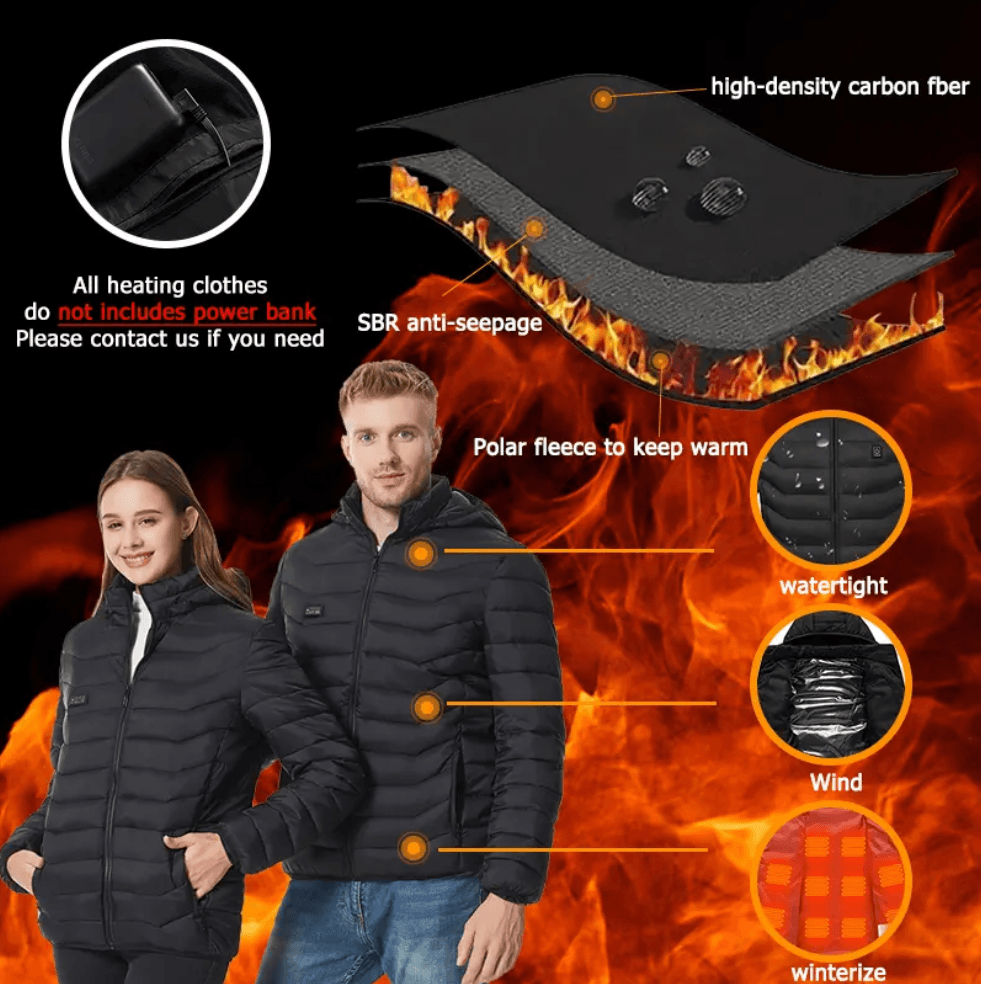
Learn how these vests prevent overheating, what "safe" means for a heated vest for men or women, and which situations (pregnancy, heart conditions, sensitive skin) call for extra care. The mechanics, the real risks, and the simple habits keep you warm without keeping you worried.
Quick Safety Verdict: Are Heated Vests Safe To Wear?
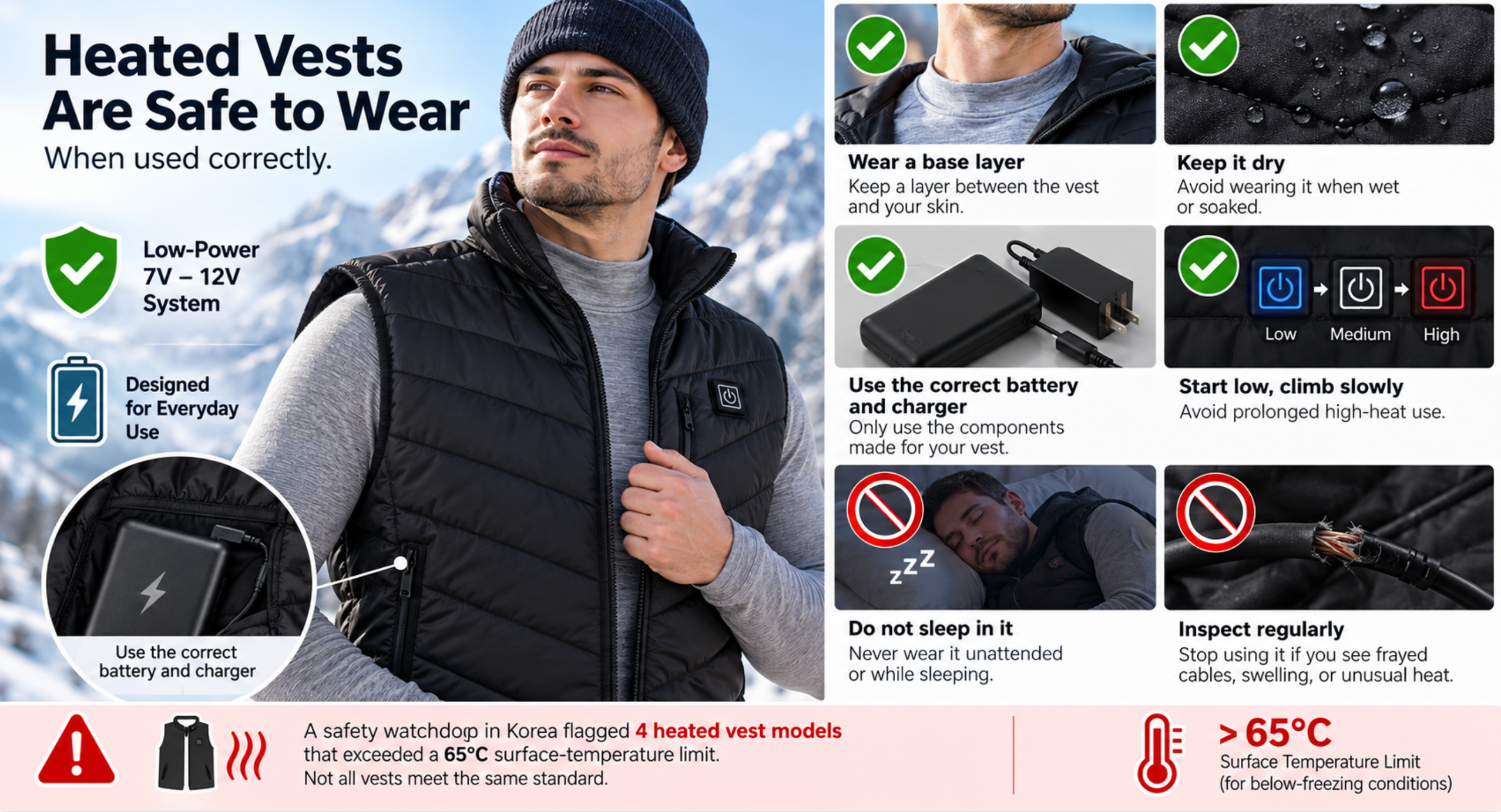
Yes, heated vests are safe to wear—as long as you use them the way they're designed. Most modern units run on 7V to 12V systems, which industry sources classify as low-power and safe for regular wear.
The real safety rules:
Wear a base layer. Never let heating elements touch bare skin directly.
Keep it dry. Wet conditions or a soaked inner lining raise the risk of electric shock.
Use the correct battery and charger. Mismatched components create genuine fire risk.
Skip prolonged high-heat use. Don't sleep in it—extended contact can cause burns.
Inspect regularly. Frayed cables, swelling, or unusual heat mean stop immediately.
One safety watchdog in Korea flagged 4 heated vest models that exceeded a 65°C surface-temperature limit set for below-freezing conditions. Not all vests meet the same standard.
How Heated Vests Work & Built-In Safety Mechanisms
Under the fabric, there's more engineering than most people expect. A heated vest is a small, coordinated system built to warm you without cooking you.
The power source stays low. Most commercial heated vests run on 5V or 7.4V rechargeable battery systems—a fraction of household mains voltage. That's why electric-shock risk stays low even when the vest gets damp or brushes against metal zippers.
The heating elements are thin, embedded pads or conductive wires, tucked into the chest and back zones. They're designed to sit against a layer of clothing, not skin. Every manual says the same thing: if the heat feels wrong, stop immediately.
Temperature control chips manage the output. A short press cycles through Low, Medium, and High, with an LED flashing to confirm which mode you're in. These settings are tightly bounded. One manufacturer lists Low at 45–50°C (113–122°F), Medium at 50–60°C (122–140°F), and High at 60–65°C (140–149°F). Another brand runs cooler: Low 38°C (100.4°F), Medium 45°C (113°F), High 55°C (131°F). Across the market, most heated vests cluster around 100–150°F total range.
Thermal protectors act as the safety net. When internal sensors detect excess heat, the module cuts power automatically—this is the core defense against overheating. Pair that with auto shutoff (standard on most modern batteries) and short-circuit protection, and you've got layered protection rather than a single point of failure.
The practical takeaway: Low is built for all-day wear. High is built for five-minute warm-ups, not marathon sessions. Manufacturers repeat this guidance because the physics backs it up—lower settings mean lower skin-contact temperature over time.
Potential Risks & Side Effects of Heated Vests
Heated vests can burn you. Not often, not dramatically, but it happens—and the pattern behind those injuries is almost always the same combination of mistakes.
Skin burns, redness, irritation, and blisters show up when three things collide: high heat, extended wear, and thin or missing insulation between the heating element and your skin. Wear it tight against bare skin on High for hours, and you're asking for a hot spot that turns into a blister by dinnertime. Vest temperatures cluster in the 100°F–150°F range, which sounds mild until it's pressed directly against skin for an entire afternoon.
This isn't theoretical. A U.S. man suffered burns from an overheated heated vest in 2017. A year later, a Canadian woman was hospitalized with burns when her heated vest caught fire. Two separate incidents, two separate countries, same underlying failure: heat and safeguards that didn't hold up.
The Battery Is Usually the Real Culprit
Electric shock is low-risk but not zero-risk. Most heated vests run on 7V to 12V, which is genuinely low power—until moisture gets involved or the unit's damaged. Water plus electronics is never a neutral combination.
Fire risk traces back to the battery, not the fabric. Wrong charger, overcharging, or a degraded battery pack can trigger thermal runaway—the point where a lithium-ion cell swells, leaks, ruptures, or in worst cases, ignites. Leaked electrolyte fluid is corrosive enough to burn both clothing and skin on contact.
There's also a sneaky mechanical risk: loose metal objects—keys, coins, screws, paper clips—bridging the battery terminals. That short-circuit scenario shows up in manufacturer warnings for a reason. A small thing causes a big problem.
Some manufacturers address this at the design stage by tightening minimum resistance standards for heating wires, reducing both ignition risk and low-temperature burn potential before the vest ever reaches you.
The risk conditions worth remembering:
High heat combined with long wear duration
Direct skin contact with no base layer
Poor insulation around heating zones
Overcharged, aging, or low-quality batteries
Non-approved or mismatched chargers
Water exposure
Visibly damaged battery packs
Every serious heated vest injury on record traces back to one or more of these conditions—not a random malfunction with no explanation.
Safer-Use Rules: How to Wear a Heated Vest
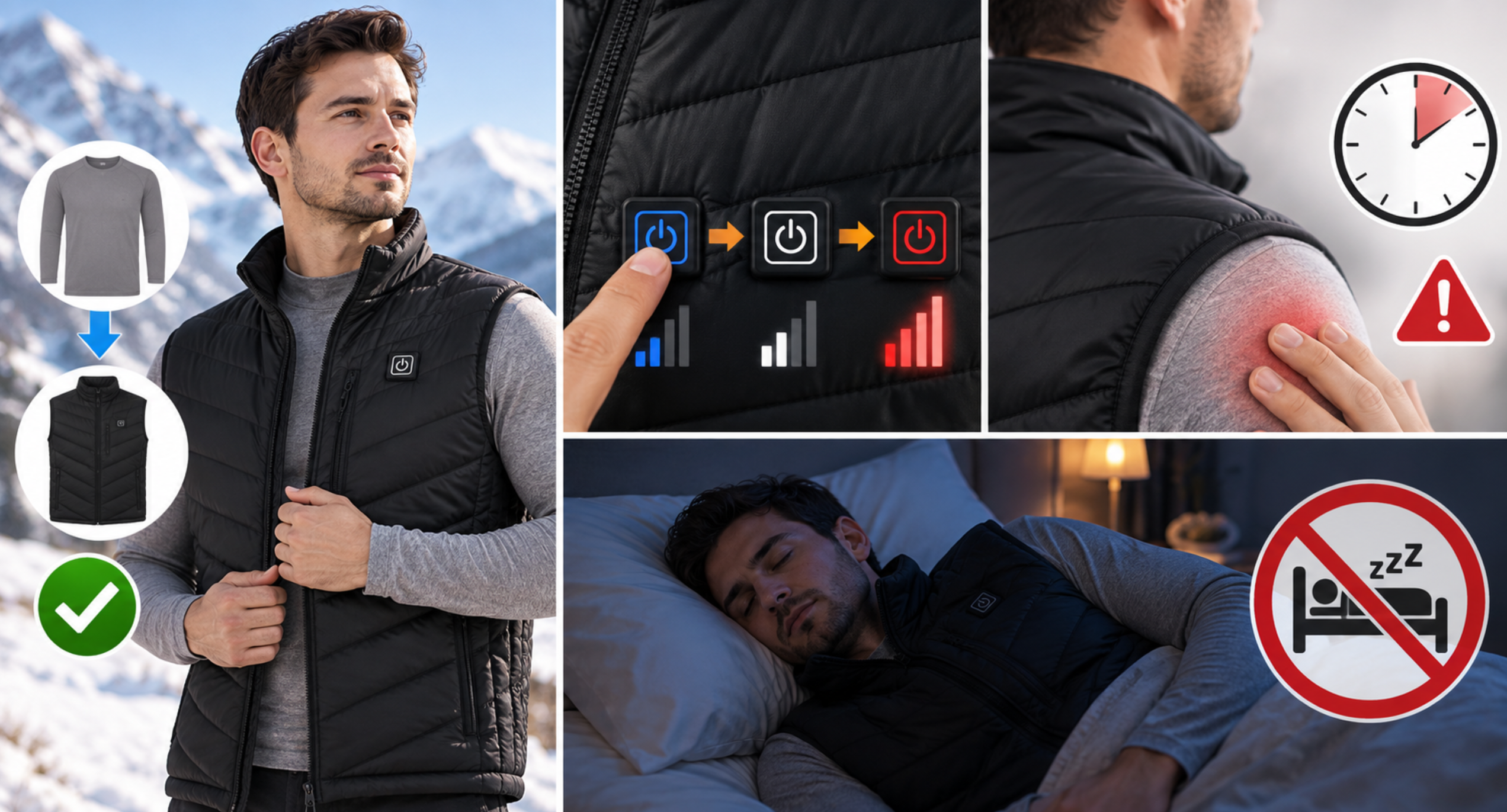
Every safety feature engineers build into a heated vest only works if you meet it halfway.
Layer it right. Never wear the vest against bare skin. Put on a base layer first, then the heated vest over it. That thin barrier is doing real work—it's the difference between gentle warmth and a hot spot that turns into a burn.
Start low, climb slowly. Don't punch the highest setting the second you zip up. Start on Low, give your body a minute to register the warmth, then dial up only if you actually need more. Manufacturers flag "prolonged high heat at close range" as a genuine risk factor, not a throwaway warning.
Watch the clock, not just the dial. If your skin turns red, tingles, or feels off, drop the setting or shut the vest off entirely. Don't wait it out.
Never wear it unattended or asleep. Don't fall asleep in a heated vest. Don't put one on someone who's asleep or unconscious. This single rule prevents most heated vest overheating incidents on record.
Moisture, Charging, and Pre-Wear Checks
Moisture is the enemy. Skip use in rain, after heavy sweating, or if the lining feels damp—wet insulation raises shock and burn risk fast. If it does get wet, disconnect the battery immediately, let everything air-dry at room temperature somewhere ventilated, and confirm connectors are bone-dry before powering back on.
Charging deserves its own discipline. Use only the original battery, charger, and cable—never a phone charger, laptop USB port, or third-party swap. Most manuals cap charging temperature between 0–40°C (32–104°F), and charging should happen indoors, away from humidity.
Before every wear: check for frayed wires, loose connectors, cracked casing, battery swelling, or unusual heat. Any of those signs means stop and inspect before you zip up again. This five-minute habit is the real backbone of heated clothing safety.
Who Should Be Extra Cautious: High-Risk Groups
A heated vest that's perfectly safe for most people can be genuinely risky for someone else. The danger isn't always the vest—it's the body wearing it. For certain groups, the core risk isn't feeling too hot. It's not feeling too hot until damage has already started.
Pregnant women. Heat exposure can raise core body temperature, and medical guidance consistently warns against prolonged heat sources on the abdomen or torso during pregnancy. If you're weighing a heated vest for pregnant women, ask your doctor first: "Could this raise my core temperature or affect the pregnancy? What's a safe upper temperature and wear time?"
Diabetics, especially with neuropathy. Reduced sensation means you may not notice overheating in time—burns happen silently. Poor circulation, common in diabetes, also slows healing afterward.
People with poor circulation (peripheral artery disease, Raynaud's). Heat pools locally instead of dissipating, raising burn risk in exactly the areas already vulnerable.
Anyone with sensory impairment—stroke survivors, spinal cord injuries, nerve damage. The heat alarm simply doesn't work right.
Heart conditions or pacemakers. Heat stress can add cardiac strain, cause dizziness, or interact with implanted devices—get device-specific clearance from a cardiologist first.
If you fall into any of these groups, talk to a doctor before regular use—not after a problem shows up.
How to Choose a Safe Heated Vest: Key Quality Indicators
Not every heated vest on the market is built the same way, and the gap between a well-engineered one and a cheap knockoff often comes down to specs most shoppers never check. What actually separates a genuinely safe product from a fire risk waiting to happen is the details below.
Voltage matters more than marketing copy. Look for vests running on 5V, 7.4V, or 12V systems. These low-voltage setups are the industry standard for good reason. Anything under 36V DC is generally considered a low-power safety zone, and the vest category mostly stays well within it.
Certifications aren't optional extras. Check for UL 2054, UL 1642, IEC 62133, and UN38.3 on the battery. These cover cell safety and transport standards for lithium batteries. On the finished garment, look for CE, FCC, and RoHS. Some manufacturers also carry ISO 9001:2015, which signals consistent factory quality control.
Look for layered protection systems. A solid BMS (battery management system) handles short-circuit cutoff, overcurrent protection, and temperature monitoring simultaneously. Some vests even auto-shutoff after roughly 90 minutes as a built-in safeguard against overheating.
Fabric and heating zones count too. Carbon fiber heating panels paired with multi-layer insulation reduce localized hot spots better than single-layer designs.
Matching the Vest to the Wearer
Heated vest for men: durable fabric, chest-and-back dual zones, larger sizing, outdoor/work-ready
Heated vest for women: slimmer fit, lighter weight, gentler temperature settings
Elderly users: one-button operation, default medium-heat startup, automatic step-down
Outdoor work: CE/UL/FCC certified, wind-resistant, strong battery life alongside overheat protection
Heated Vest vs Heated Jacket: Which Is Safer?
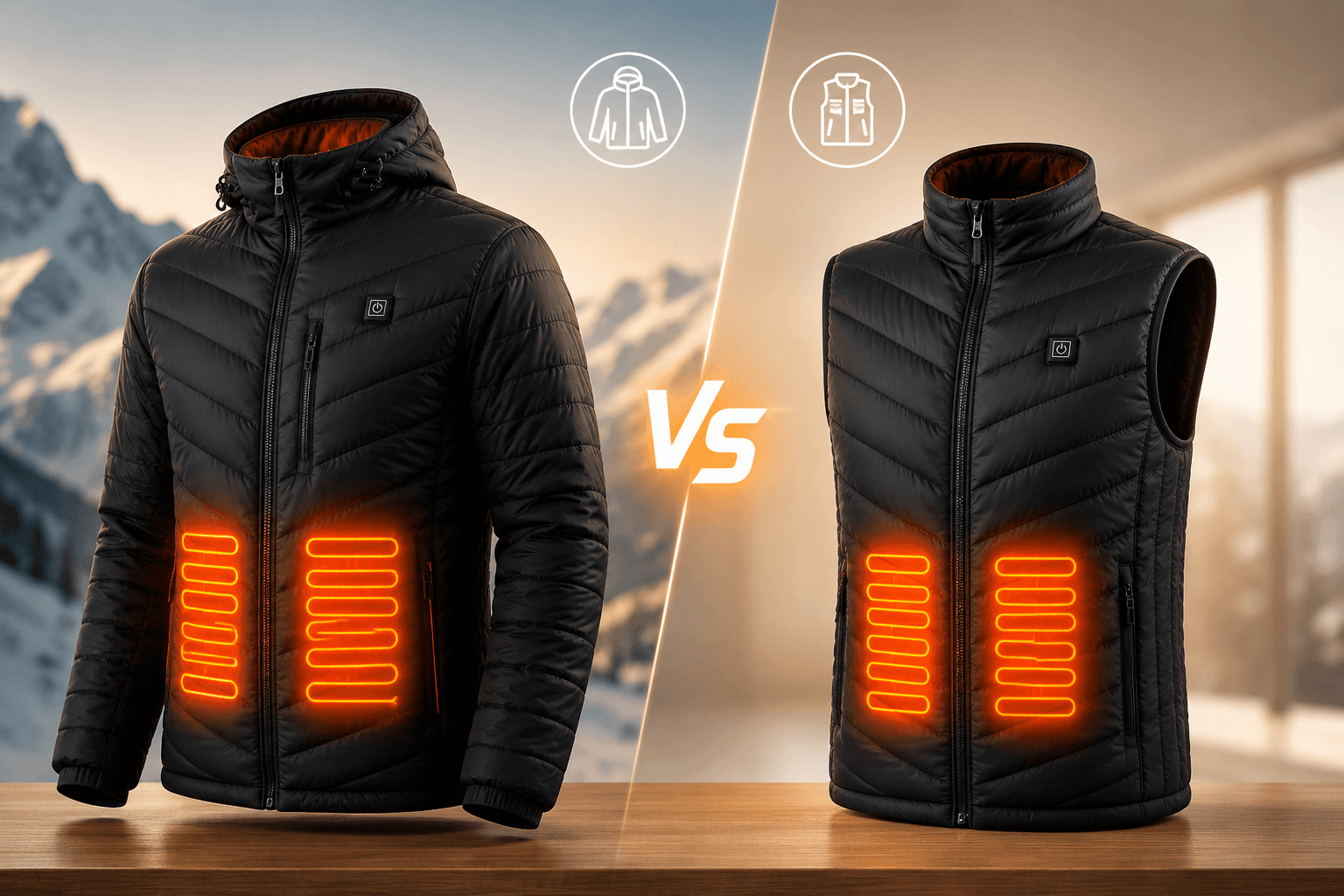
Neither wins outright. The safer choice depends on what you're doing and how cold it actually is.
Coverage tells the story. A heated vest warms your core: chest, back, sometimes the collar. A heated jacket for men or women adds sleeves and shoulders, covering more skin but running more heating elements at once. More heated surface means more power draw and more zones to monitor for hot spots.
For mobility, the vest wins. Sleeveless design keeps your arms free—better for hunting, layering under outerwear, or any activity where shoulder movement matters. Vests also concentrate heat over fewer carbon-fiber panels, which makes overheating easier to catch and control.
For extreme cold, the jacket wins. Full arm coverage cuts wind-chill exposure that a vest simply can't reach. If you're sitting still for hours in brutal temps, that added coverage becomes a safety factor, not just comfort.
Quick rule: active outdoor use or hunting → vest. Stationary, severe cold → jacket. Either way, confirm overheat protection, short-circuit prevention, and CE/FCC/UL2056 certification before buying.
FAQ: Common Safety Questions About Heated Vests
Can heated vests catch fire?
Only if you ignore the rules. Manuals tell you not to expose the vest to open flame or high-heat environments, and not to use anything except the designated battery pack. Swap in the wrong battery, and the risk of injury and fire is real.
Can you wash a heated vest?
Yes. Pull the battery out first, tuck the connector back into its pocket, zip everything closed, then hand wash or run a gentle cold-water cycle. Skip bleach, ironing, wringing, dry cleaning, and the dryer.
How long does a heated vest last?
Battery longevity depends on maintenance. Ororo's manual recommends a full charge every six months during storage. That simple habit keeps the pack usable season after season.
Can pregnant women wear heated vests?
Guidance is mixed, but manuals flag heat-sensitive users and poor circulation as reasons to stay cautious. Keep settings low. Stop at the first sign of discomfort.
Can you wear it against bare skin?
No. Manuals advise against direct skin contact.
Can you use it wet?
Never. A wet lining raises electric-shock risk.
Conclusion
Heated vests are safe to wear if you choose one with genuine safety certifications, respect the temperature settings, and follow common-sense usage rules. Overheating, burns, and battery risks are almost always the result of low-quality materials or careless use. Safety depends on certified components (CE/FCC/UL), smart low-temperature protection, and knowing your own body's limits — especially if you're pregnant, diabetic, or have sensitive skin.
Before you buy, check for safety certifications, read the manufacturer's temperature guidelines, and start on the lowest setting to see how your body responds.